目次
On Cups, Tea, and Vikings
皆さま、こんばんは。
今夜も穏やかにお過ごしでしょうか。もっとも、この時間まで起きている方の多くは、夜更けまで仕事に励んでいたり、あるいは無数の光る機械に囲まれて何やら大切な用事を片づけていたりするのかもしれませんね。
さて、私たち鬼―慎ましくも誇り高き妖怪の一族―にも、そうした商いのような営みがあるのかと、不思議に思われるでしょうか。
人間の皆さまが余暇に思いつくような壮大なビジネスには及びませんが、私たち鬼一族も腕力を鍛え、戦いに備え、夜になれば宴を開いて飲み食いするだけの一族ではありません。もちろん、それらが「人生で最も大切なこと」の大半を占めているのは確かですがね。
Good evening dear readers, and I hope this night finds you peaceful and at ease, though I suspect many of you are burning a midnight candle, or more likely surrounded by multiple glowing instruments engaged in some important bit of business. Now, you may be wondering if we Oni, a humble but great yokai family, also might busy ourselves in commerce of this nature. Well, while it may not compare to the sort of grandiose designs that you humans get up to in your spare time, I should say that despite our reputation for being entirely preoccupied with accomplishing great feats of strength, practicing fearlessness in combat, and, in the evenings, partaking in great feasting, drinking, and regalements, this is not entirely accurate (though I must confess this does entail the bulk of what our society considers “what is best in life”).
私たちは酒造りにも長けていますし、棍棒を鍛える技術にも自信があります。妖怪の中でも、丈夫で長持ちする下着を縫わせれば右に出る者はいないでしょう。(100年履いても破れない~♪)
もっとも、そうした職人技は、代々受け継がれてこそ価値があります。そのためには、「sharp teeth of time that eat away all things (時というものは鋭い牙で万物を少しずつ食い尽くしていく)」という事実を忘れてはならないのです。この言葉はたしかエピクロスのものだった……ような気もしますし、違ったなら似たような哲学者だったのでしょう。もしそれも違うというなら、私の高高高高祖父叔父―ええ、正確にはまだ健在なのですが―の話を信じていただきたいものです。
御年二千七百四歳。昔ほど身軽ではありませんが、この知恵は「時間そのものと同じくらい古い」と断言しております。
そう考えると、時間そのものもずいぶん年老いて、永遠へ急ぐ必要もないせいか、少し歩みを緩めているのかもしれませんね。
For we have many masterful methods of brewing ale, forging clubs, and sewing the strongest and most resilient undergarments among the yokai. Such endeavors necessarily require the sort of artisanal lineage that would be all but impossible to maintain if we weren’t mindful of the “sharp teeth of time that eat away all things,” as I believe it was Epicurus to first remark, and if not him, then some other fellow of a similar school I should think, and if this too is a misattribution, may the reader be assuaged that my great great great great granduncle who lived to be…well, in plain fact, he’s still alive now, though at 2,704 years old he’s not as spry as he once was – at any rate, he swears this is bit of wisdom is as old as time itself. And I should think, time itself too is rather getting on in years and perhaps has been slowing down a bit seeing as there’s no immediate rush to eternity.
さて、本当にお話ししたかったのは「カップ」についてです。
どのような器が最も優れているのか―これは静かに腰を据えて考える価値のある話題だと思っています。
プルタルコスの『リュクルゴス伝』によれば、古代スパルタ人は実に巧妙な杯を作っていました。飲み口へ土や小石、不純物が流れ込みにくいよう工夫されていたそうです。当時は、清潔な飲み水を手に入れることが今ほど当たり前ではありませんでしたからね。
一方、日本の縄文人もまた見事な職人でした。彼らの土器は世界最古級と考えられており、「火焔型土器」と呼ばれるものなどは、炎が燃え上がるような姿で実に壮観です。ただ、お茶をすすりやすい形とは少々言い難い気もいたします。
At any rate, what I really wanted to tell you all about today was this business of cups and what the best sorts were, for it’s something that really does require a bit of quiet reflection to properly get ahold of in one’s mind. The ancient spartans, according to Plutarch’s life of Lycurgus, were known to craft cups of great worth that were highly praised for their clever function of naturally filtering the bits of debris, earth, or impurities away from drinker’s mouth. One must remember that in those days the management of clean drinking water wasn’t such a given as it is now. The Jomon peoples of very ancient Japan were great artisans too, and their earthenware pottery is thought to be some of the oldest in the world with some pieces exhibiting the so-called “flame-style” that looks most striking and impressive but doesn’t seem particularly ideal for sipping a cup of tea.
ところで、お茶という飲み物は世界中で親しまれているだけあって、茶器の種類も驚くほど豊富です。
「でも南極では違うでしょう」と思われた方もいるかもしれません。しかしそれは、ペンギンやアザラシには普通のティーカップの取っ手をつかむ手がないからだと思っています。
もし、資金不足と投資家の想像力不足のせいでサッカーチーム結成を断念した起業家が、その情熱を別の方向へ向けたならどうでしょう。(詳しくはAka-oniブログ「なぜアメリカ人はサッカーを好まないのか」をお読み下さい。)フリッパーに取り付けられる器具と、特製の魔法瓶を組み合わせれば、南極の寒さに震えるペンギンやアザラシも、温かな紅茶を楽しめるはずです。
南極では一年中が冬のようなものですからね。
もし本当にそんな商品があれば、まさに「誰も手をつけていない市場」というやつでしょう。見た目に反して、私たち鬼は案外商売っ気があるのです。
Incidentally, “tea-cups” have quite the impressive variation given the fact that the beverage is consumed nearly everywhere on earth. Yes, I know what you’re thinking, “Well, probably not in Antarctica,” but I should think that’s only because penguins and seals do not have appendages that readily allow for the consumption of this delightful brew as gripping the handle on a standard mug or teacup would prove nearly impossible. But now, just imagine for a moment if some enterprising soul, who let us say, had foregone his initial idea of putting together a soccer team due to lack of funding and frankly lack of imagination among investors, were really to put his nose to the grindstone he could most assuredly fashion a kind of flipper attachment to a sort specialized Dewar flask (what is more commonly known as a Thermos) that would allow those poor chilly flightless birds and their sea-dog friends to have nice cup of tea on a cold winter’s day – which is apparently everyday in Antarctica, regardless of the season. Now, there’s a truly “untapped market” if there ever was one (you see, we Oni, despite all outward appearances really are quite enterprising if given only half a chance).
「A Nice Cup of Tea(すてきな一杯の紅茶)」という題名をご存じでしょうか。
実はジョージ・オーウェルが1946年、ロンドン・イブニング・スタンダード紙に寄稿したエッセイの題名で、彼はそこで「黄金律」と呼ぶ紅茶の淹れ方を11項目にまとめています。ご存じでしたでしょうか?
……私も最近まで知りませんでした。
もっとも、イギリス人ですから紅茶好きなのだろうとは思っていましたが。
ところが、もう一人の有名なイギリス人―正確には架空の人物ですが―ジェームズ・ボンドは紅茶が大嫌いでした。イアン・フレミングの『ゴールドフィンガー』では、映画には出てこない場面で「紅茶は泥だ」と言い放ち、紅茶に夢中なイギリス人をぼやいているのです。
さて、オーウェルは「紅茶はこの国の文明を支える柱の一つであり、その淹れ方を巡って激しい論争が起こる」と書いています。
ここで改めて申し上げたいのですが、私たち鬼は恐ろしい存在だと思われていますが、こうした細かな作法を巡って本気で争ったりはいたしません。
私の見るところ、人間というものは少々文明化されすぎているのかもしれません。もっとも、私は田舎育ちの一介の鬼にすぎませんが。
イギリスのティーカップはたいてい陶器製で、「ソーサー」という受け皿が付いています。きっと、テーブルから口元まで運ばれるあいだ、カップが寂しくならないようにでしょう。
一方、フランスのリモージュでは美しい磁器が作られ、豪華な装飾のカップが並びます。ロシアでは厚手の切子風グラスに金属製のホルダーを付けた「ポドスタカンニク」が使われます。この名前、くしゃみをした拍子に思わず口から飛び出した言葉のようにも聞こえますね。
Speaking of this phrase, “A Nice Cup of Tea,” did you know that the author George Orwell wrote an essay with this very title wherein he laid out eleven gules for making a cup which he, “regarded as golden,” in the London Evening Standard back in 1946? Neither did I! Although I had assumed that, being an Englishman, he would have a fondness for tea. Though, another famous Englishman, albeit a fictitious one, James Bond by name, absolutely abhorred the stuff. (Yes, it’s true! You can read about it in Iam Flemming’s novel Goldfinger – this line isn’t in the movie – wherein Bond requests coffee not tea and states rather flatly that “tea is mud” and goes onto lament the fact that English people are so obsessed with the beverage in question). But, back to Orwell, in the essay he claims that, “tea is one of the mainstays of civilisation in this country and causes violent disputes over how it should be made.” Once again, I must note, dear readers, that despite our reputation for violence and general fearsomeness, we oni are not so prone to senseless brawling over these sorts of fussy details that dictate far too much of human behavior. Mankind is really far too civilized for its own good in my estimation, though I am but a humble, country oni. Now, the English teacup is generally ceramic and comes with something called a saucer, presumably to keep the cup company in case it gets lonely traveling all the way from the table to the mouth. Whereas in the French town of Limoges there is a special porcelain and ornate cups are made with very ornate designs, and in Russia they serve tea in a thick, faceted glass cup with a special kind of metal jacket for the cup with an accompanying handle called a “podstakannik” which sounds a bit like the sort of thing one might say if one were to violently sneeze mid-sentence.
こうして眺めてみると、カップというものは実に奥深い存在です。
日本では茶道に用いられる茶碗があり、器というより小ぶりの鉢のような姿をしています。
さらに歴史をさかのぼれば、中国は茶と磁器のふるさとです。私は、この二つはできれば同じ頃に発明されていてほしいものだと思っていますが、本当のところは分かりません。
中国では茶は「開門七件事」の一つに数えられています。その中には酢も含まれていますが、不思議なことに「すてきな一杯の酢をどうぞ」と勧められることはまずありません。
これもまた、翻訳では伝わらない何かなのでしょうか。
This business of cups, you see, is quite complicated indeed and in Japan for the centuries old tea-ceremony the cup rather more resembles a bowl of sorts. If one goes even further back to China, the origin of tea and porcelain (and I’d like to think the two probably should have been discovered at around the same time for simplicity’s sake, though I cannot be sure this is true) is inseparable from the country itself, with tea being known as one of the “seven necessities of life,” among which is also vinegar. Yet, strangely enough one doesn’t often ask for a “nice cup of vinegar,” so, perhaps this too is something “lost in translation.”
ところで、鬼にも自前の酒器があるのか―その答えは、もちろん「あります」。
とはいえ、一族の誇る技術をあまり詳しくお見せするわけにはいきませんので、代わりに私たちが深い親近感を抱いている人々をご紹介しましょう。
ヴァイキングです。
姿形は違えど、その気質にはどこか通じるものがあります。
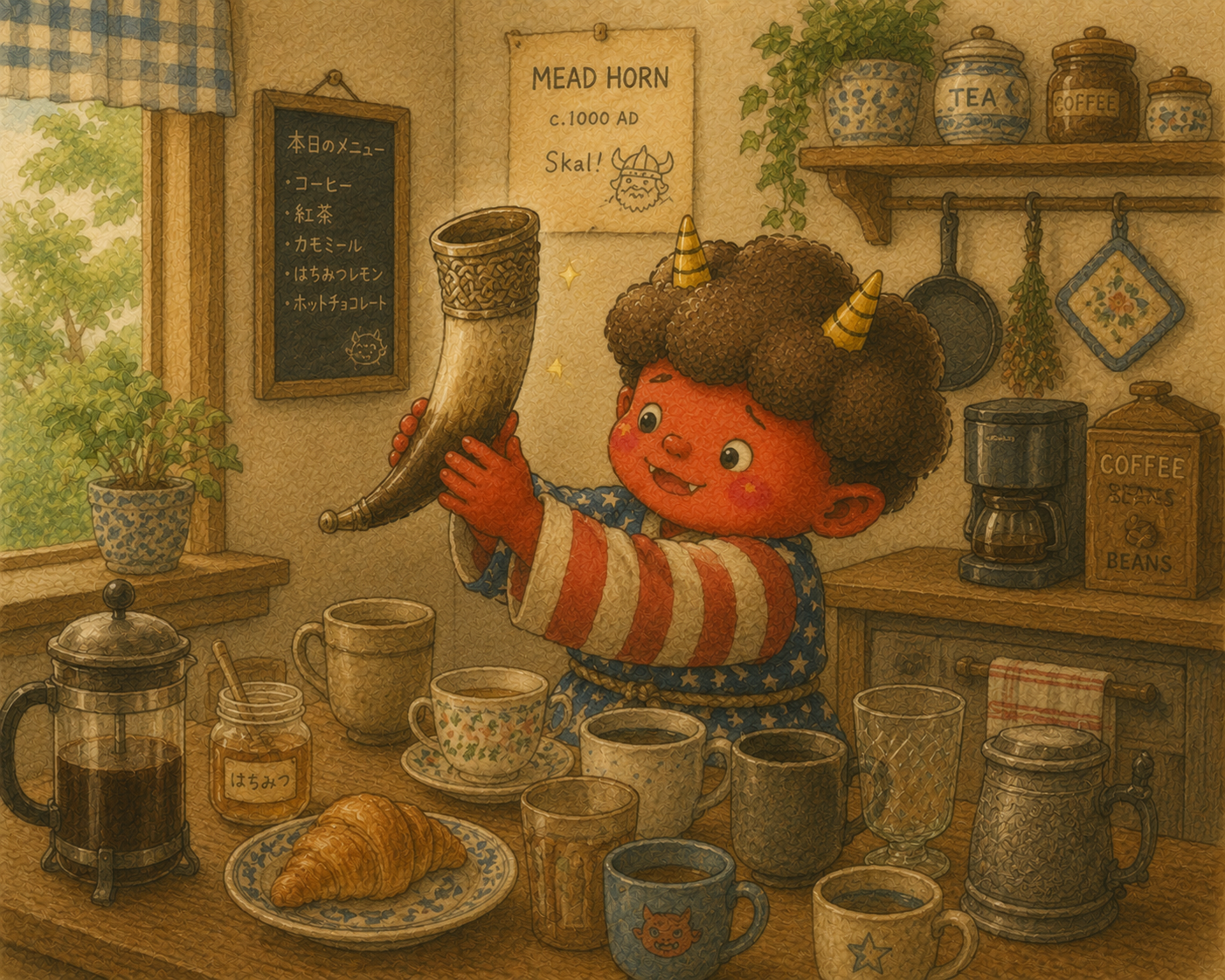
私の高高高高祖父叔父によれば、古代デーン人ほど見事なミードホーンを作った者たちはいなかったそうです。
若き日の彼は、北の大海への危険な旅の末、一つのミードホールへ流れ着きました。疲れ果て、空腹で、身寄りもないまま勇気を振り絞り、こっそり宴の席へ紛れ込みます。
その夜、彼は数え切れないほどの素晴らしい光景を目にし、多くの英雄譚を耳にし、そして角杯に注がれたミードを何杯も味わいました。
漂流者だった自分が、いつしか歓迎される客になっていた―その経験は、まさに天啓だったと申しております。
鬼は角が生え替わります。抜け落ちた古い角は、たいてい役にも立たず、少々見栄えの悪いものとして扱われます。
しかし、ヴァイキングたちが角を酒器として見事に生かしている姿を見た彼は、その場で鍛冶場を築き、「鬼特製ミードホーン」の製作を始めました。
やがてその品は北欧中で評判となり、難破で失った財産を取り戻したばかりか、大いに富を築きます。
その後、彼は「リーフ・エリクソン」という男とともに、西の果ての未知なる大陸へ旅立ちました。
そう、親愛なる読者の皆さま。
これこそが、私たち鬼がアメリカへ渡った始まりなのです。
巡礼者たちよりずっと前の話ですが、その程度で鼻を高くするほど子どもでもありませんので、ご安心ください。
You may be wondering if we oni make our own cups, and I am very happy to say that we do indeed! And though I don’t wish to reveal too much of our clan’s marvelous engineering, I will instead direct your attention to a group of humans that we regard, in many respects, as kindred spirits despite being very different creatures, namely: The Vikings. For it was the ancient spear Danes whom, according again to my aforementioned great great great great uncle, who fashioned the most splendid and regal mead horns in days of yore. When he was but a small stripling of an oni, and after a most perilous journey to the great seas of the north, he stumbled upon a great mead hall. Weary, hungry, and alone, he gathered his courage and silently snuck in among the great Shieldings and their feastings. That eve, he beheld many a wondrous site, heard many a great tale, and drank many a horn of mead. Truly, they were most hospitable guests and from this most fortunate experience wherein he went from shipwrecked waif to welcome guest, he was struck with what can only be called divine inspiration. For we oni, you know, must shed our horns from time to time and for the most part we regard the old horn as largely useless if even a bit unsightly. But after seeing firsthand the ingenuity and cleverness of those great warriors and how eminently suitable a spare old horn could be for a drinking cup, he immediately set to work on building his own little forge and his own one-of-a-kind “Oni Mead Horns.” Well, in a few years time his wares became coveted throughout the lands of the Norse peoples, and so profitable was his enterprise that he not only recovered all that he had lost in the shipwreck and more, but began again anew sometime later with a fellow called “Lief Ericcson” on a great adventure to a yet undiscovered land far to west, and that, dear readers, is how we came to America! Well before the pilgrims, mind you, but we shan’t let this go to our heads.
それでは皆さま、また次回お会いいたしましょう。Until next time my friends!
What a splendid land this is, and how lovely are its people! Fear not, I promise not to eat anyone!
-Aka-Oni