目次
On Keeping Time
親愛なる読者の皆さま、ごきげんよう。お元気でお過ごしでしょうか。
前回のお話を覚えていてくださる方なら、人間という存在が時間をどれほど鋭く意識しているかにも、きっと頷かれることでしょう。私は以前、友情や勇気、冒険心といった人間の美徳は、その短い寿命ゆえにひときわ尊く輝くのだと申し上げました。
燃え盛る炎が一瞬で薪を燃やし尽くすように、人間の輝かしい魂は花火のような鮮烈さを持っています。その刹那の美しさには、いつも感心させられるのです。
それに比べれば、もし鬼に欠点があるとすれば、長い寿命とさらに長い歴史を持つがゆえに、数え切れないほどの恋や英雄譚を見聞きして育つことでしょう。そのせいか若い鬼たちは、フランス人が「アンニュイ」と呼ぶような、あるいは鬼の言葉で言えば「まあ明日でいいでしょう」という気分に陥りがちなのです。
Salutations my dear readers, and I hope this message finds you well. I trust that many of you have a very keen sense of time and rightly so, for as I mentioned in our previous chat one truly admirable thing about mankind when it displays its finer virtues such a friendship, courage, and passion for adventure is that humans have such a comparably brief span to express these most praiseworthy traits. This makes it all the more brilliant and striking when they are witnessed, like a bright flame burning with such intensity that it consumes its fuel in an instant, glorious fury – truly like fireworks are some of the grandest human souls. And by comparison, I must confess that if we oni do have any lamentable faults it is that our long-lived folk and even longer history is so full of incredible tales of great romance, that many of the younger generation find themselves in a state of what the French call “ennui,” or what we oni call “perhaps-tomorrow-ness.”
もっとも、それを怠け癖や向上心の欠如と片づけるのは、少々不公平でしょう。
鬼は「もっと良い機会はこの先にあるかもしれない」と考えることが多いのです。だからこそ、今あわてて失敗するより、未来に巡ってくる好機を待とうとします。
そんな気質のおかげで、季節や時代、運が良ければ時代そのものの移り変わりには人一倍敏感です。しかしその一方で、「火曜日の午後3時15分」という感覚は、どうにも実感が湧きません。
おそらく鬼があまり腕時計をしないのも、そのためでしょう。もちろん以前、人間の服装に夢中な叔父の話をしたように、時計を愛でる鬼がまったくいないとは申しません。
I don’t believe it’s quite so accurate or even fair to say that this is an indication of mere sluggardness or lack of ambition, but rather more that we often consider that better prospects may arise for great action and so, better to trust to future opportunity than to rush into present disaster. It is for this reason that we oni have, on the one hand a very sensitive and innate appreciation of the seasons, the ages, and, if we are fortunate enough, even the epochs of time, but on the other hand it is for the very same reason that we have quite the vague impression of, for example, what “3:15 pm on Tuesday” really means. Perhaps this is why we don’t often wear watches. Of course, as I noted before regarding my uncle’s curious fascination with human fashions, I am certain that there are timepiece connoisseurs among our kind if not among my own kin.
もちろん、数字が読めないわけではありませんし、太陽の位置を見れば一日のだいたいの時刻くらいは分かります。
ただ私には、人間が時間というものをここまで厳密に管理しようとする姿が、なんとも不思議に映るのです。
たとえば七月の真ん中の二週間を思い浮かべてください。天気も気温も大きく変わらない時期なら、感覚としては長い二、三日が続いているようなものではありませんか。
アメリカにはサマータイムという制度があります。私は「地球と太陽の位置関係によるものなのですか」と、科学好きの従兄に尋ねたことがあります。彼は「いや、あれは完全に実務上の理由だよ」と教えてくれました。言い換えれば、かなり政治的な事情なのだそうです。
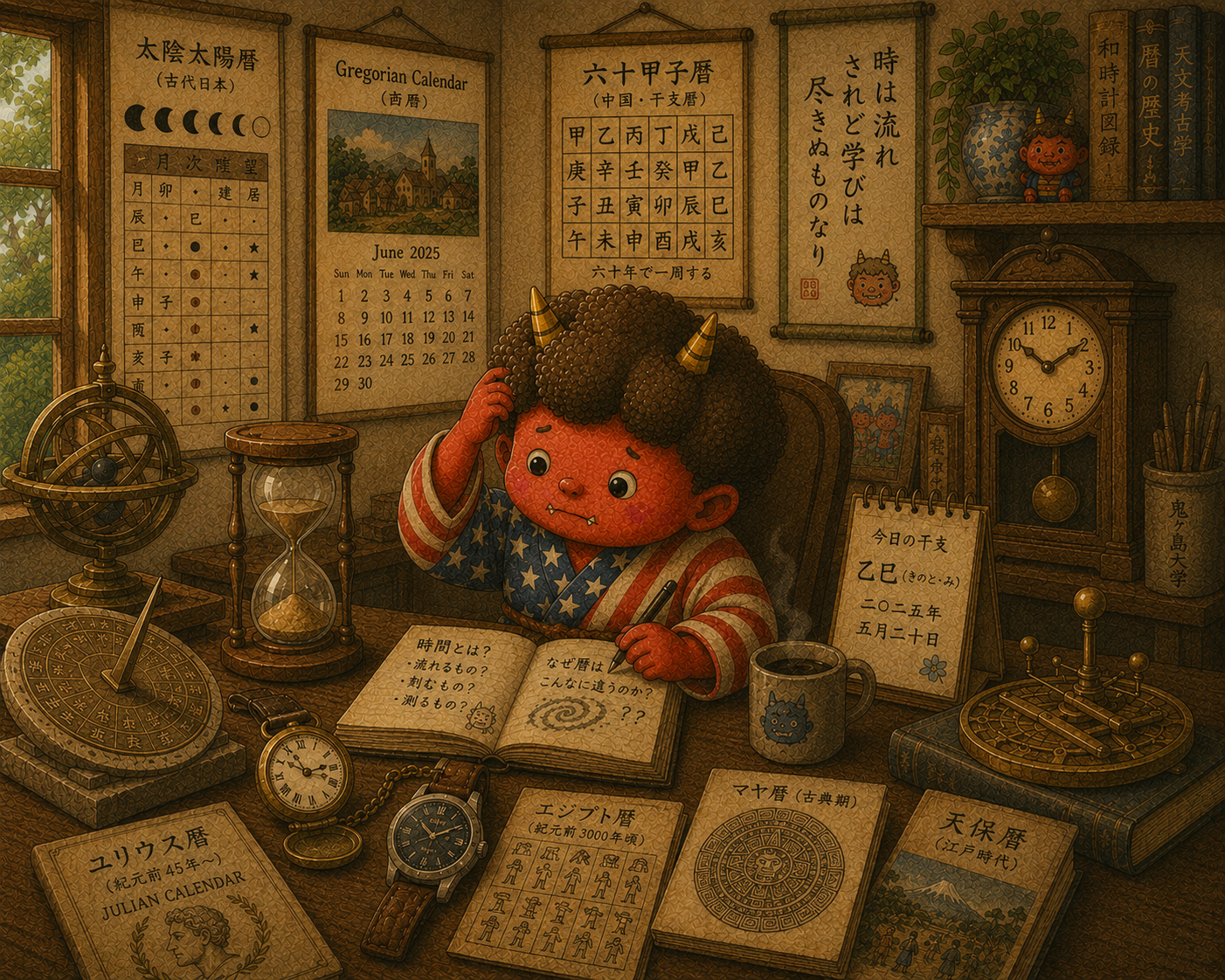
日本を含め、多くの文化では太陰暦を用い、祭りや儀式、農作業に合わせて時間を区切ってきました。そのほうが、人の暮らしには自然だったのでしょう。
At any rate, I don’t mean to say that we can’t read the numbers or ascertain by the position of the sun roughly what “time of the day” it is, but more that we find it curious how exacting humans are when it comes to this business of keeping time. Why just think, for example, how two weeks in mid-July might as well be two or three very long days if one considers the limited variation of weather patterns and temperature. As some of you may be aware, in America there is the practice of “daylight savings” which has nothing at all to do with the position of the Earth in relation to the sun (yes dear readers, I did ask my “science obsessed” cousin regarding this matter and he assured me that the reasoning for this practice was entirely practical, which his to say largely political). And indeed, many peoples of mankind, including the Japanese, have used a form of the Lunar calendar with special allotments of time made for accommodating various festivals, rituals, and agricultural practices.
だから私は、もう少し肩の力を抜いた時間の捉え方があってもよいのではないかと思うのです。
「夏は日が長く、冬は日が短い。」
誰もが知る当たり前の言葉ですが、24時間という数字だけでは表せない真実があります。
時計も、午前午後という区切りも、ひとまず脇へ置いてみましょう。少しだけ、自分自身の感覚を信じてみるのです。
従兄の科学を信じるなら、七月の午後6時も二月の午後6時も、確かに同じ時刻なのでしょう。しかし夏の午後6時は、夕日が赤く町を染めながらゆっくり地平線へ沈み始める時間です。対して冬の午後6時には、外はすっかり闇に包まれ、雪でも降っていそうな静けさがあります。
それでも時計は「どちらも午後6時です」と平然と言い張るのです。
ここで腕時計や携帯電話、目覚まし時計など、あらゆる数字に囲まれて暮らしている皆さまは、「それは地域によって違いますよ」と指摘したくなるかもしれません。
Therefore, it strikes me as most reasonable to consider a less exacting and more useful means of keeping time. Consider the saying “the days are longer in summer and shorter in winter” and how plain and true it is despite the fact that the “same 24 hour period” has passed. Let us ignore timepieces and numbers and this business of AM and PM for a moment and instead trust to our own senses. Let us be sensible, and not so abstract for a moment. Now, if my cousin and his “science” are to be believed then, yes we must concede that 6:00 pm on late July evening and 6:00 pm in the middle of February are in fact “the same time of day,” but this feels deeply unsatisfying especially when glancing out the window and noticing the plain truth that, in the summer the early evening is bathed in a soft reddish hue as the sun begins to lazily dip below the horizon, and in the winter at the exact same “6:00 pm” it is already black as pitch and most probably snowing. At this point many of you poor souls festooned with watches, phones, alarm clocks, and a myriad of other devices that continuously assault your poor eyes with numbers indicating “the time” will be quick to point out that this phenomenon varies by region.
あるいは「南極ではどうなのです」と、ペンギンやアザラシの話を持ち出したくなる方もいらっしゃるでしょう。季節によっては午後6時が朝6時のようであり、太陽が沈まず一晩中陽気に宴を続けている場所もある、と。
ですが、それこそ私の言いたいことなのです。
数字だけで時間を定め、それを標準として押し通そうとしても、私たち自身の感覚は、それに素直には従ってくれません。
太陽が長く空にあれば一日は長く、早く眠れば一日は短い。それで十分ではありませんか。
私はさらに、こうもお尋ねしたいのです。
時間を正確に測ろうとしたことが、本当に大切なものを守った場面と、それによって余計な苛立ちを生んだ場面とでは、どちらが多かったでしょうか。
以前、ある大手コーヒーチェーンの記事を読んだことがあります。行列が一定以上長くなると、客がレジへ着く前に注文だけ先に取る、という取り組みについてでした。
No doubt some of you are tempted, yet again, to bring up our mutual friends the penguins and seals in Antarctica and describe how their “6:00 pm” might look very much the same as our “6:00 am” depending on the season and how the sun never sets at all somedays in the polar regions, but instead stays up all night carousing in a sort of bacchanalian frenzy of joy and feasting. But you see, dear readers, this only goes to prove my point all the more. It hardly is useful to have these “time numbers” and various devices that keep track of said numbers when our very senses would prove to contradict their silly, bureaucratic claims for “standardization.” Days are longer when the sun is up longer and shorter when the sun goes to bed sooner, and we oni, by in large, simply don’t see much utility in complicating things any further than this. I would also put it to you another way, how many times is this sense of exactitude been the source of great frustration rather than the preservation of something dear? I once read an interesting piece that noted the practice of a certain large coffee shop chain which involved taking people’s orders in line – if the line was determined to be beyond a certain desirable length – before they approached the counter.
私は当然、「なるほど、待ち時間が短くなるのですね」と思いました。
ところが後になって、その仕組みは平均待ち時間をほとんど縮めていなかったと知ったのです。
では、何のためだったのでしょう。
答えは「待ったと感じる時間」を短くするためでした。実際に経過した分数ではなく、人の感じ方を変えることが目的だったのです。
つまり、ダブルエスプレッソが早く届いたわけではありません。ただ、そう感じやすくなっただけでした。
せっかくなら、その数分を少し違うことに使ってみてはいかがでしょう。
たとえば、なぜ紫という色が長いあいだ特別な色だったのか。本物のティリアン・パープルで染められた衣を目にしたなら、古代の人々と同じように、その神秘的な色彩に魅せられるのではないか─そんなことを考えてみるのです。
My natural conclusion was, “Ah yes, this certainly should’ve sped things up,” but it was later revealed that this policy made only a small, if entirely negligible, difference upon the average wait time for any given order. So what was the purpose of this if no appreciable efficiency gains were realized? Apparently it was all in “perception” of time passed as opposed to the real “number of minutes” that had, on average, transpired. In other words your double-espresso did not arrive any sooner than had you simply waited patiently. Despite patience being its own reward, let us further reflect upon how you could’ve used those few extra minutes to consider something stimulating and worthwhile like, why purple was such as sought after color for so long and if we could see a true Tyrian purple robe in all its glory then, perhaps we too have the same fascination with the mysterious hue that ancient man did many years ago?
そこから思いはさらに広がります。
ティリアン・パープルの発見が、ルーベンスの《ヘラクレスの犬、紫染料を発見する》という絵画になったことを思い出すかもしれません。
英雄譚には、なぜ忠実な犬がたびたび登場するのでしょう。言葉を話せないにもかかわらず、芸術や物語の中でこれほどまでに大切な存在として描かれてきた犬とは、なんと見事な生き物なのでしょう。
そして「自分の暮らしにも、あんな良き友が一匹いてくれたら」と想像した、そのときです。
「失礼しました。ダブルエスプレッソのお客様。」
―「ああ、私です。ありがとうございます。」
つい先ほどまで煩わしい待ち時間だったものが、少しだけ心を遊ばせる豊かな休息へ変わっているではありませんか。
ほんの少しだけ、心を自由に歩かせてあげれば、それだけでよいのです。
And from here you might let your mind drift a bit more and consider how the moment of this discovery had been commemorated in Peter Paul Rubens’ Hercules’s Dog Discovers Purple Dye and then further think how many great heroes have had a faithful canine companion and what marvelous creatures they must be despite being deprived of human speech to feature so prominently in great tales and great works of art. From here you might consider how much your own days might be improved with such a good creature and loyal friend at your side and –“Sorry? Oh yes, I ordered the double-espresso, thank you very much!” So what was perviously construed as an inconvenience and downright nuisance can easily become a welcome respite from the needless bustle and business of your day, if you would only give your mind half a chance to stretch its legs and wander a bit.
想像力が少し足りなくなると、不思議なことが起こります。
時計ばかり見ている人ほど、時間の流れを自分で感じ取れなくなり、結局は同じ結果になるにもかかわらず、「並んでいる間に注文だけ先に取ってください」と望むようになるのです。
こうして考えると、セネカの言葉はやはり見事です。彼は『ルキリウスへの道徳書簡』でこう記しています。
「人はなんと愚かなことか。安価で取るに足らないものを手に入れれば、その代価はきちんと払う。しかし最も尊い財産である時間を与えられても、自分が借りを負ったとは考えない。しかも時間という貸しは、どれほど感謝しても返済することはできない。」
実に、鬼らしい鼻の利く方ではありませんか。
時間を無駄にするのは残念なことです。しかし、曾祖父はこうも申しておりました。
「時間を上手に無駄にする術を知らぬことも、また大きな損である。」
And it seems this lack imagination is what creates the very absurd situation wherein people who are glued to their timepieces have such a poor internal perception of its flow, that they demand someone to take their order while they wait in line only to get the exact same result as if they had given their order at the counter. Hence, we come to understand that Seneca, as in many other regards, was quite right when he mentioned that time was the only true thing in itself which nature had entrusted to mankind. Why just look at this lovely passage, from his Moral Letters to Lucilius:
“What fools these mortals be! They allow the cheapest and most useless things, which can easily be replaced, to be charged in the reckoning, after they have acquired them; but they never regard themselves as in debt when they have received some of that precious commodity,—time! And yet time is the one loan which even a grateful recipient cannot repay.
Now, here is a man with what I call a real “oni’s nose” for the truth of the matter, for indeed it is most unpleasant to consider time wasted but also, if I may interject with a proverbial saying of my great grandfather, “Also a great shame to not know how to waste time well.”
運命が少し微笑み、ミューズが気前よくしてくれる日には、私たちは活動と活動のあいだに、小さな「pauses」を授かります。
日本語では、それを「間」と呼ぶのだそうですね。
宮崎駿監督は、あるアメリカ人記者にこの「間」を説明する際、「手を打って、次に打つまでの間です」と語ったそうです。記者は、作品の中で登場人物が何もしていないように見える場面が好きだと話していました。
宮崎監督は、その「休み」があるからこそ、その前後の動きに意味が生まれるのだと説明しました。休みがなければ、すべては慌ただしい動作の連続になってしまうのです。
このことこそ、私が皆さまへお伝えしたかった、小さな鬼の知恵です。
長く生きる鬼にとって、この「間」や「休み」を味わうことは、ごく自然な感覚です。しかし人間は、その短い命ゆえに、それを身につけるまで少し努力が要るのでしょう。
列が少し進まないとき。夏の夕日が、もう少しだけ沈むのをためらっているように見えるとき。
そんな瞬間は、時間そのものがくれた静かな休息です。その休みがあるからこそ、そのほかのすべての動きに意味が宿ります。
どうか、そのひとときを大切にしてください。
それは滅多に訪れない、天からの贈り物なのです。
たとえ腕時計が止まってしまっても、その休息はどこにも消えません。
謙虚に、そして少しだけ辛抱強く手を伸ばけば、きっとそこに待っていてくれるでしょう。
それでは皆さま、また次回お会いいたしましょう。Until next time, my friends!
For when the fates are kind and the muses charitable we are often given this wonderful pauses or what the Japanese call “間” the sort of “nothingness” in-between activities. As film director Miyazaki Hayao once remarked, this “間” is the “pause in between clapping your hands” while explaining the concept to a slightly befuddled American reporter who noted how much he loved the small moments in between scenes in his films wherein a character was doing nothing in particular. Miyazaki went on to describe how these “rests” are essential, otherwise the motions in the scene simply become meaningless busyness. And this is truly wherein I wish to impart to you, my dear readers, a small piece of rusticated oni wisdom. For, you see, a sense for appreciation these “breaks” or “rests” comes as second nature to us, as we are so long-lived and, if I may say, such a storied folk. Yet, I fear that humans – through their own blameless frailty – often must work quite hard to understand these things. When you encounter these tiny moments of delay and when you look on as a summer sunset wanes and refuses just a bit longer to give way to the evening, you are catching a small glimpse of precious rests in time, moments of peace that make all the other movements purposeful instead of just random busyness. You must learn to take hold of these moments, for they are most rare and a boon from the heavens. Know that even if your watched had stopped, they would – if you are patient and humble – still be waiting for you to grasp if would only stretch out your hand.
Until next time, my friends!
“What a splendid land this is, and how lovely are its people! Fear not, I promise not to eat anyone!”
-Aka-Oni