目次
On The Two Types of People and Second Hand Things
読者の皆さま、ごきげんよう。本日もお元気でお過ごしでしょうか。
ちょうど用事を済ませて帰ってきたところかもしれませんし、これから友人との集まりや何かの予定へ向かうところかもしれません。あるいは、「出かけようか、それとも家にいようか」と考え込んでいる最中でしょうか。
外出するとなれば、あれこれ準備もしなければなりません。どんな面倒が待っているかを思い浮かべながら、少し慎重に計画を立てる人もいるでしょう。そうした用心深さが、あとで余計な苦労を避けてくれることもありますからね。
もちろん、そんな心配とは無縁で、今日は部屋の静かな居心地のよさを満喫しながら、どこへも出かける予定などないという方もいらっしゃることでしょう。
Greetings dear readers, and may this message find you well and in good spirits. Perhaps you are just returning from some errand or en route to some activity or gathering of friends. Or perhaps you are in that in between sort of time when you are debating whether or not to undertake some task or go on some outing. Perhaps just now you are considering all the options and various difficulties you are likely to encounter, for you know it is no slight matter to set out into the wider world and a bit of precaution and extra planning now may save you from a great deal of grief or unpleasantness later. Or, perhaps you’re under no such stress and have no immediate plans to set out for any extended period or indeed even leave the comfort and pleasant solitude of your room.
私が見ているかぎり、人間にはこの点で大きく二つのタイプがあるように思えます。
ひとつは、社交的で活動的な人たちです。家でどれほど快適に過ごせるとしても、近所の食料品店へ出かける程度のことですら、一つの小さな冒険として楽しめるような人たち。
もうひとつは、思索を愛する人たちです。どれほど壮大な冒険へ誘われても、家で古典を読み、静かに考え事をし、ときどき家族や友人が訪ねて来るくらいがちょうどよいと感じます。よほど重要な使命でもないかぎり、放浪の騎士のように旅へ出たいとは思いません。(この典型としては、J・R・R・トールキンの『ホビット』に登場するビルボ・バギンズを思い浮かべていただくと分かりやすいでしょう。)
もっとも、本当に充実した人生には、この二つの気質がどちらも必要なのだと私は思います。時と場合に応じて外へ向かう心と、内へ向かう心。そのどちらか一方だけに偏るのは、あまり望ましいことではありません。
There seem to be, as near as I am able to discern, two distinct types of humans in this regard. By that I mean to say there are the sort of gregarious, outgoing, restless types who – even if afforded every comfort and convenience of the hearth – would much rather set out on some adventure, even if this was nothing more than stopping at the local grocer. Then there are those who are the sort of pensive, contemplative, scholastic types who – even if afforded a chance at a very grand adventure – would much prefer to stay home and luxuriate in the works of the ancients and the pleasures of thought, with the occasional visit of friends and relations and not bother themselves with setting out like a knight errant, unless of course it was some quest of utmost necessity (See J.R.R. Tolkien’s character of Bilbo Baggins in his marvelous work The Hobbit for an excellent example of this archetype). Now, it should be said, dear readers that a truly fulfilling life should incorporate, in the appropriate degree and at the appropriate time, both of these types and a life spent overly focused on the pursuit of one at the expense of the other is also something to be avoided.
イギリス文学を代表する詩人ジョン・ミルトンは、この対照を実に見事に描いています。
『陽気な人(L’Allegro)』では、若さと自然、喜びに満ちた人生を歌い、『沈思する人(Il Penseroso)』では、静寂のなかで知恵を求める人生の豊かさを描きました。
皆さまは、この二篇をご存じでしょうか。あるいは詩集『1645 Poems』を読まれたことはありますか。もしまだでしたら、ぜひ一度手に取っていただきたい作品です。英語という言葉そのものが持つ宝物のような詩なのです。
まずは『陽気な人』から少しだけ。
John Milton, perhaps other than Shakespeare the greatest of all English poets, noted this striking contrast in his companion poems Il Penseroso, which describes the pleasures of a life spent in the pursuit of wisdom in peace and quiet, and L’Allegro, which speaks of the joys of a life filled with youthful merriment, enjoying the splendor of nature, and mirth. Have you read either one or any of the poems from his collection, 1645 Poems? If you haven’t you simply must, as they are a treasure of the English language itself.
Why just listen to this passage from L’Allegro (meaning “the happy man”):
“The Mountain Nymph, sweet Liberty;
And if I give thee honour due,
Mirth, admit me of thy crue
To live with her, and live with thee,
In unreproved pleasures free;
To hear the Lark begin his flight,
And singing startle the dull night,
From his watch-towre in the skies,
Till the dappled dawn doth rise;
Then to com in spight of sorrow,
And at my window bid good morrow,”
そしてこちらが『沈思する人』です。その調子の違いに耳を澄ませてみてください。
And now, note the comparative tone in Il Penseroso:
“Com pensive Nun, devout and pure,
Sober, stedfast, and demure,
All in a robe of darkest grain,
Flowing with majestick train,
And sable stole of Cipres Lawn,
Over thy decent shoulders drawn.
Com, but keep thy wonted state,
With eev’n step, and musing gate,
And looks commercing with the skies,
Thy rapt soul sitting in thine eyes:
There held in holy passion still,
Forget thy self to Marble, till
With a sad Leaden downward cast,
Thou fix them on the earth as fast.
And joyn with thee calm Peace, and Quiet,
Spare Fast, that oft with gods doth diet,
And hears the Muses in a ring,
Ay round about Joves Altar sing.”
実に見事な詩ですね。
……おや、いけません。私は今日は詩の話をしようと思っていたわけではありませんでした。
今日お話ししたかったのは、人間という種族が作り出す品々のことです。
鬼の目から見ると、人間ほど小物や装飾品や道具を次から次へと生み出す生き物はいません。その量には本当に驚かされます。
もちろん、私たち鬼にも鍛冶や木工、醸造、裁縫といった手仕事はあります。しかし、人間の作る物の規模と量は比較になりません。
それほど膨大な品々を、人間はいったいどうしているのでしょう。
どうやら、そのかなりの部分は捨てられてしまうようです。そう考えると、そもそもなぜそこまで大量に作る必要があったのか、不思議でなりません。経済的には「織り込み済み」なのかもしれませんが、私には何とももったいない話に思えるのです。
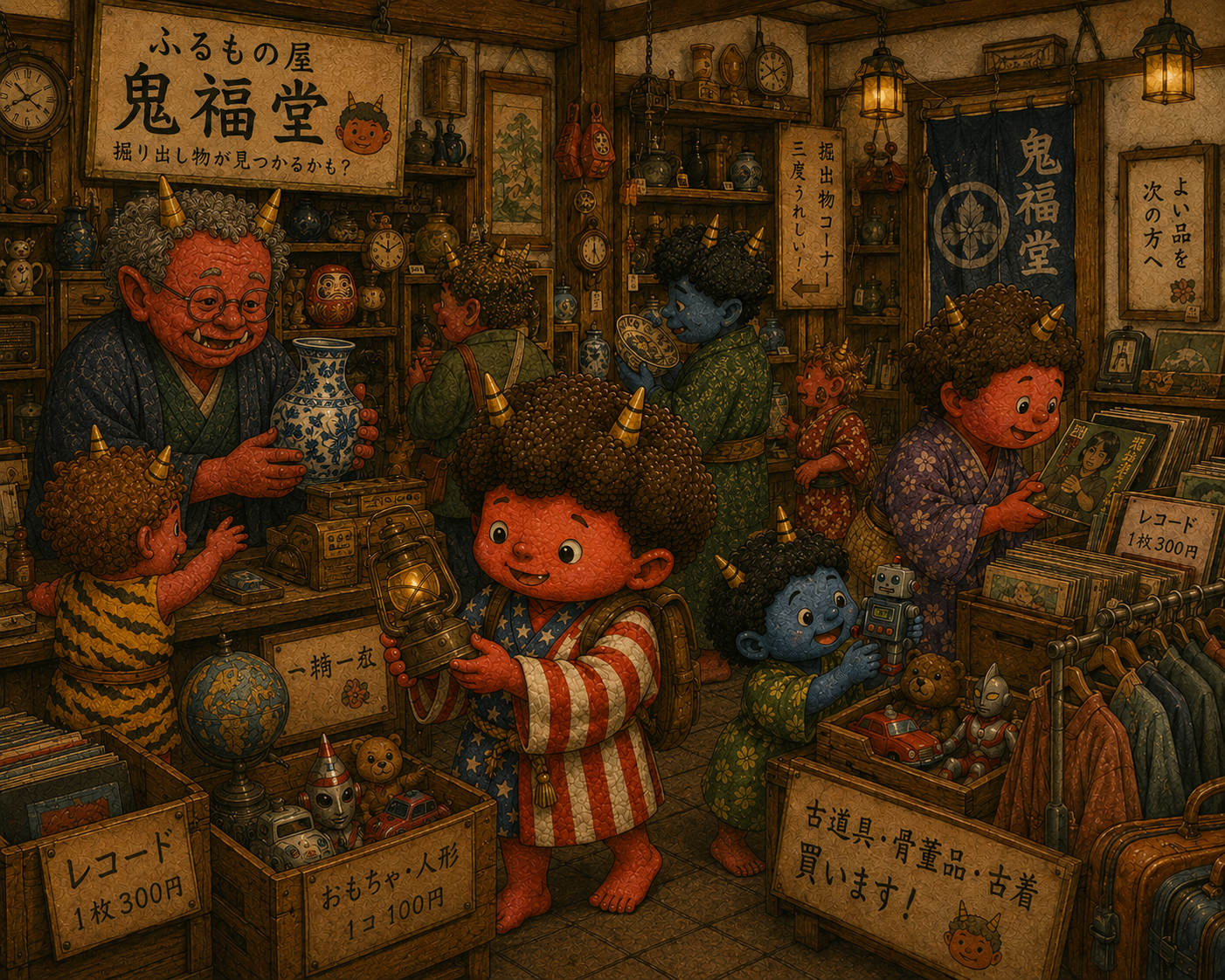
もっとも、人間にはもう一つ、実に賢い仕組みがあります。それが「リサイクルショップ」や「アンティークショップ」と呼ばれる場所です。
Marvelous, isn’t it? But, gracious me…where was I? Oh, yes! I meant to talk with you today about something else entirely. Namely, I wished to share that one of the more curious things about mankind, as far as we oni are concerned, is the seemingly never-ending amount of trinkets, baubles, and other various curio you are capable of producing. It’s a truly staggering thing. Oh, I don’t mean to imply we oni are entirely bereft of skills of smithing, carving, brewing, baking, sewing, and other essential handiwork and artisanal labors, but when compared to mankind, why the sheer scale alone is mind-boggling. And what does one do with all this stuff, all these goods, all these glittering commodities? Well, as it turns a great deal of it seems to be thrown away, which begs the question as to why it was necessary to produce such an enormous volume in the first place, and it strikes me as really a terrible waste even if the economic cost is, I assume, either negligible or “priced in” as I’m told some humans are fond of repeating when it comes to these sorts of bizarre manufacturing processes. However, another far less depressing and I think much better practice exists in the form of what are called “second-hand” or sometimes “antique shops.”
これは人間の実に優れた発明です。
古い品をため込んだり捨てたりする代わりに、世界中の小さな店へ集め、新たな持ち主のもとで再び役立てる。実に理にかなっています。
実は鬼の世界にも、それによく似た店があります。「人間用品店」です。
人間の品物には独特の魅力があります。ただ、多くは鬼には少々壊れやすく、あるいは人間の細く器用な手に合わせて作られているため、私たちには扱いづらいのです。以前、電話の話でも触れましたが、人間の精密な道具は鬼にはなかなか骨が折れます。
Now, this is really a clever development on the part of mankind, that instead of hoarding all these old things or simply throwing them away, there are millions of tiny shops dotted all about earth with many old goods in quite fine condition that can be made useful once again. If I may offer another glimpse into our own yokai world, it may surprise you to learn that our “human wares” stores function in a very similar capacity. You see, human goods have a certain charm and quality to them in spite of the fact that many are ill-suited for yokai due to their comparatively fragile composition or, more often than not, due to the fact that they are “human-sized” and designed for human hands which, while quite admirably dextrous, are quite the intricate, spindly appendages and, as such, the finer workings of your precision machinery and even your basic goods are quite difficult for the average oni to operate properly (As you know, I’ve mentioned this before concerning telephones and other contraptions).
私は田舎育ちの、ごく平凡な鬼です。しかし年齢や立場を考えると、鬼の中では比較的よく旅をし、人間の世界にも詳しいほうだと言われています。
自慢ではありません。ただ、多くの鬼は人間の品物に興味を持ちながらも、それが何に使われ、どう作られているのかまでは知りません。
そのため私は、ときどき「人間用品店」で相談役や鑑定役のような仕事を頼まれていました。
実は私が最初に見習いとして任された仕事は、「人間の書物」を分類することだったのです。その役目を与えてくれたのは、とても大切な叔父でした。(ええ、以前お話しした叔父とはまた別の叔父です。私どもはなかなか大家族なものでして。)
それ以来、本への愛着だけはずっと変わっていません。
As I am a humble, country oni, you may surprised to learn that I am considered – for my age and rank that this (perhaps more on this another time) – to be a comparatively well-traveled, well-versed, and somewhat knowledgeable oni, especially in regards to human affairs. I don’t mean to boast, but rather to illustrate that for the great majority of oni there is a certain unspoken general interest in “human goods,” without a very precise understanding of what they are used for, how they are made, and so on. As such, I often rendered my services to “Human Wares” stores as a sort of, well, “consultant” you might say or “appraiser.” Indeed a very dear uncle of mine (yes, a different uncle altogether from the others I’ve mentioned previously, for we are a rather sizable clan) gave me my first apprenticeship as a cataloguer of “human writings” hence my longstanding and deep fondness for books.
そうして人間の物語に魅せられたことが、人間の世界そのものを知りたいという気持ちにつながりました。
旅を重ねるうちに、日本に暮らす鬼の親類とも出会い、人間たちの暮らしや文化を少しずつ学んでいったのです。
ここで皆さまは、こんな疑問を抱かれるかもしれません。
「それほど人間の品物が好きなら、鬼も似たような物を作ればいいのでは?」
もっともな疑問です。
けれど、古いカメラを集める人が、自分でレンズを設計しようとはあまり思わないでしょう。ヴィンテージの革ジャンが好きだからといって、革職人になる人もそう多くはありません。
鬼も同じです。
多くの収集家にとって魅力なのは、作り方ではなく「その品そのもの」。
もっと簡単に言えば―
「酒は造るより飲むほうが好き。」
そういうことなのです。
It was from this initial fascination with the tales of men, that I set about trying to learn more about the world of mankind and through my travels and trials came to first meet some of my dear Japanese cousins and, in time, learn their ways and the ways of their land’s humans as well. You may be asking yourself, “Well if oni are so fascinated with human goods, why do they not try to make similar items?”
And, to this very natural inquiry, I should put it to you that it’s quite rare that a person, say a man with a fondness for old cameras or what I’m told are called “vintage” leather jackets would ever decide to design his own lenses or take up a trade as a tanner. We oni are quite similar to humans in this regard in that the novelty of the item itself holds far more interest to the general “collector” as opposed to the means of its production or the techniques required to make it. To put it even more simply, “most prefer to drink ale rather than to brew it.”
では、鬼たちはどんな物を珍重するのでしょう。
私は専門家ではありませんが、中には「ボタン」に取り憑かれたような鬼もおります。
鬼の衣服には、そもそもボタンを使う機会がほとんどありません。私たちの服は、着る者とともに歳を重ねる少々不思議な仕立てになっていますが、その秘密は、また別の機会にお話ししましょう。
だからこそ、鬼にとってボタンは不思議で魅力的な存在なのです。
人間でいえば、珍しい切手や野球カード、あるいはコミックを集めるような感覚でしょうか。
実際、極めて珍しいボタン一つと引き換えに、大量の金や広大な土地が取引されたという話もあります。
海辺の立派な屋敷を売り払い、その代わりに世界で最も珍しいボタンを手に入れ、「自分ほど幸運な妖怪はいない」と満足していた大富豪の鬼の伝説まで残っています。
人間から見れば、ずいぶん妙な話に聞こえるかもしれません。
けれど、人間にも実にさまざまな趣味や収集がありますね。そう考えると、私たち鬼も、それほど奇妙な存在ではないように思えてきませんか。
いつの日か、人間と鬼の世界がもう少し穏やかにつながるようになったなら、鬼たちも古道具屋を開いて、人間のお客さまを迎えられたら素敵だと思っています。
居間に飾る美しい品を見つける方もいるでしょうし、あるいは、とびきり履き心地のよい下着を持ち帰る方もいるかもしれません。
そんな日までは、どうか皆さま、今日という一日を心穏やかにお過ごしください。
外へ出るのが好きな方も、家で過ごすのが好きな方も。
また次回、お会いしましょう。Until next time!
Now, perhaps you are curious what goods or items are especially prized by us oni? Well, I do not claim to be any authority on the matter as it is outside my realm of what might be called “expertise,” but there are those oni who have what can only be called a mania concerning buttons. You see, we very rarely have the need for these kinds of fasteners and our clothes are made with a most ingenious method that allows them to grow old with us, but I am afraid I am not at liberty to describe the process in any great detail, but perhaps that will change in time. At any rate, their very superfluousness in oni life makes them all the more curious and enchanting to those “bitten by the button bug,” as we say. As a result human buttons represent a very special kind of novelty and are valued similarly as rare stamps, or baseball cards, or comic books might be among humans. Why some oni have traded huge sums of fine gold or even whole parcels of rich land for a particular button judged to be most rare. There was even a legend about a very old and very rich oni who sold his magnificent seaside villa for the rarest of buttons and thought himself the most fortunate of all yokai to have made the trade. I expect this must all sound rather silly and strange to you. Then again, if one considers the enormous range of human hobbies and collections, perhaps it might have the reverse effect of making us seem a bit less alien despite our very different worlds. I do hope someday when things are a bit more mended and settled among our worlds, that we oni too may set up our own antique shops where human guests may come from time to time and bring home something lovely for their living room or perhaps simply acquire a pair of truly unbeatable undergarments. Yes, I know such times are likely a long way off, but until then my friends I wish you all a pleasant day, whichever type of human you may be.
Until next time!
“What a splendid land this is, and how lovely are its people! Fear not, I promise not to eat anyone!”
-Aka-Oni