目次
On the importance of misperceptions
(AND AIR CONDITIONING)
親愛なる読者の皆様、ご機嫌いかがでしょうか。
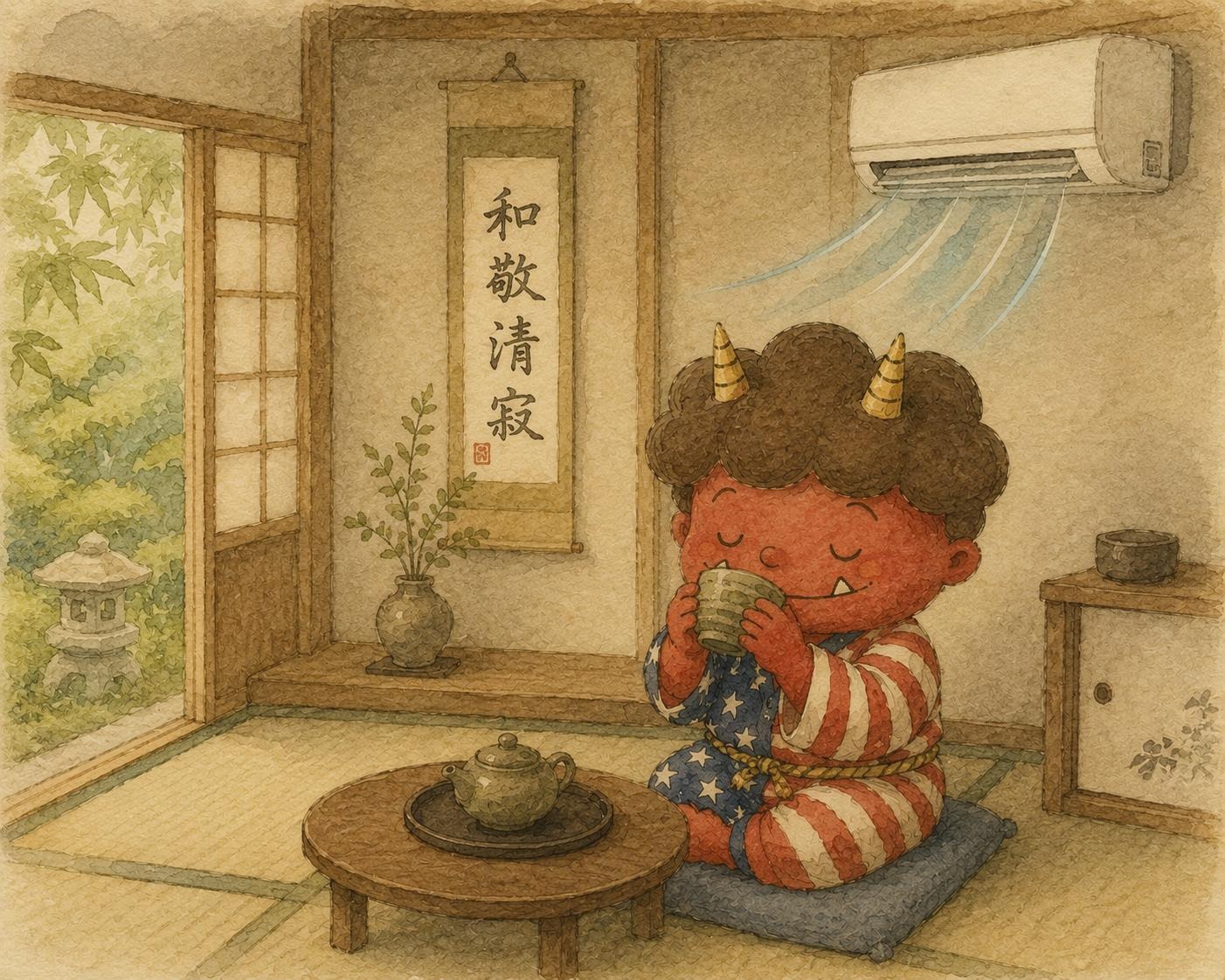
日が長くなり、気温もぐんぐん上がってくるこの季節。人類へのアメリカ最大の発明にして贈り物―エアコン―を使うことへの、いわれのない非難に、皆様はすっかり慣れておられる頃ではないでしょうか。
そう、すでにご存じの方も多いと思いますが、この人類への偉大な恩恵を生み出したのは、1900年代初頭の天才的なアメリカ人技術者、ウィリス・キャリア(キャリア・コーポレーション創業者)でございます。
そして数多くのアメリカの発明と同じように、日の出ずる国の人々はこの見事な発想を取り入れ、「もっと小さく、もっと効率的に」という、今やおなじみの精神で、独自の素晴らしい進化を遂げました。
私のような鬼がエアコンをこれほど愛しているのは、不思議に思われるかもしれません。しかし、灼熱の太陽や湯気の立ち上る温泉で鍛えられた日本の親戚とは違い、アメリカ生まれの私は、気温が24度―「FREEDOM UNITES(自由な国の単位)」でいえば約75度―を少しでも超えると、たちまち汗が止まらなくなってしまうのです。
Greetings dear readers, I hope you are well and now that the temperatures begin to precipitously rise as the summer days lengthen and grow warmer, I also hope you are all thoroughly inured to the needless chastisement of those who would begrudge you the use of one of America’s greatest inventions and gifts to mankind, “the air conditioner.” Yes, as you may already be aware, this great boon to humanity was invented by the brilliant American engineer Willis Carrier (founder of the Carrier Corporation) in the early 1900s. And like with so many wonderful American inventions, the people of the land of the rising sun have taken a genius idea and established their own brilliant variation, which seems to follow the now time-tested adage of, “let’s make it smaller and more efficient.” You might think it strange for an Oni like myself to be overly fond of air conditioning, but please recall that unlike my Japanese cousins who are tempered by the blazing sun and simmering onsens, as an American I begin to perspire most intensely if the ambient air temperature so much as rises above 24 degrees celsius (or roughly 75 degrees in FREEDOM UNITS).
どういうわけか、ヨーロッパやイギリスでは、多くの人々―そして、おそらくは少なくない妖怪たちも―エアコンに対して妙に敵対的な考えを抱いているようでございます。四季の自然な巡りを乱せば、復讐心に燃える神々の怒りを買う。そんな恐れが、どこかにあるのでしょうか。
もっとも、半神であれ妖怪であれ、「熱中症で倒れたくない」と願うだけの者たちを容赦なく罰するような存在がいるとすれば、それは正気を疑いたくなるほど冷酷な気質の持ち主に違いありません。
これは、今後の執筆や旅の題材として実に面白そうです―もっとも、エアコンなしでは夏の旅など到底考えられませんので、訪ねるのは冬に限られそうですが。
For some reason, it would appear that many people and I assume many other Yokai in Europe and the United Kingdom have a very strange and even hostile view towards air conditioning, and I suppose this is due to some sense of fear that usurping the natural rhythms of the seasons will incur the wrath of some vengeful deity. I can only speculate that any such creature, demigod or Yokai, would certainly be of unsound mind and an unkind disposition to so cruelly punish the dwellers of its domain for simply not wishing to pass out from heat exhaustion. Perhaps this shall be an excellent topic for future writings and indeed future travels – though only in the winter months, as the absence of air conditioning would make a summer excursion quite impossible.
ちなみに、この話を日本人のいとことしていた時、彼がこの現象を実に的確に表した、とあるやり取りを聞かせてくれました。
日米文化交流の一環で日本を訪れていたアメリカ人のホームステイ客―しかもアメリカンフットボールの選手です。「サッカー」や「フィートボール」と混同なさいませんように―が、日本のホストファミリーの家で初めて「エアコン」に出会った時のお話でございます。
Incidentally, while talking the issue over with a Japanese cousin of mine, he related the following exchange that summarized this whole phenomenon rather neatly. It concerns the visit of an American house-guest (a football player nonetheless – not to be confused with “soccer” or “feetball”) on a “cultural exchange” visit to Japan and his first encounter with “air-con” at his Japanese host’s dwelling.
「壁についているこれ、エアコンですか?」
部屋に落ち着くなり、アメリカ人のゲストは日本人のホストに尋ねました。
「ええ。このリモコンをお使いください。ボタンの説明は英語のシールを貼っておきました」
そう言ってホストは、「cool」と大きく書かれた星形のシールが貼られたリモコンを手渡しました。
「ありがとうございます。でも、これを使ったら家中が寒くなりませんか?」
ホストファミリーに迷惑をかけたくなかったのでしょう。アメリカ人のゲストは少し心配そうに続けます。
「オリエンテーションで、エアコンは使いすぎないようにと言われたんです。皆さんが凍えてしまったら困りますから!」
しばし沈黙が流れました。
日本人のホストは身振り手振りを交え、即席のピクトグラムまで描きながら、「セントラルエアコン」という概念を何とか説明しようとします。
そして、ようやくこう答えました。
「ああ! なるほど! その心配はいりません。このエアコンは、あなたのお部屋だけを冷やすものですから」
その瞬間、アメリカ人のゲストも「ああ、なるほど!」と声を上げました。
「つまり……壁掛け式のエアコンが、家の各部屋に一台ずつ付いているってことですか?」
「ええ。そのほうが一人ひとり好きな温度にできますし、効率もいいんです。それに、一台壊れても家全体が暑くなることはありませんから」
実に見事な指摘でございます。
「ああ、確かに。でも、うちだったら十台くらい必要になりそうだな。それじゃ結局、高くつく気がする」
するとホストは少し困ったように笑って答えました。
「そうですね。でも、日本ではそこまで大きな家は……あまり一般的ではありません。それに、そのような広い家は田舎に多くて、エアコンが付いているのは一部屋だけ、ということも珍しくありませんよ」
これは、アメリカ人のゲストにはまったく想像のつかない話でした。
「えっ、それじゃ夏の間、みんな一部屋に集まって過ごすんですか?」
信じられない、という表情です。
「うーん……私にもはっきりとは分かりませんが、アイスクリームやスイカを食べたり、普通の扇風機を使ったりして涼んでいるのではないでしょうか」
ホストは、日本の田舎での暮らしを何とか伝えようと、一生懸命説明しました。
「おお! まるでアニメみたいだ!」
アメリカ人のゲストは、目を輝かせて言いました。
「ええと……まあ……そうですね。まさにアニメのようなものかもしれません」
これ以上説明すると、かえって話がややこしくなる。ホストはそう判断したのでしょう。
「それって、すごくcool だね!」
アメリカ人は、本当にうれしそうでした。アニメで見た世界が、現実にも少しだけ存在していると知ったからです。
そこで日本人のホストは、勇気を振り絞って英語で冗談を返しました。
「Actually… it’s very hot, isn’t it?(実際は、とても暑いんですけどね?)」
一瞬、死んだような沈黙が流れました。
しかし、その次の瞬間。
大柄なアメリカ人のゲストは大笑いしながらホストの背中をぽんと叩きました。
「ああ、その通りだ!」
こうして、また一つ友情が生まれたのでございます。
“This thing on the wall, that’s the A/C?” asked an American home-stay guest to their Japanese host upon getting settled into his room.
“Yes, you can use this remote and, there is a sticker in English to help explain the function.” replied the host, handling the neatly labeled remote to their houseguest with the word “cool” emblazoned on a shiny, star-shaped sticker.
“Oh, thank you very much, but won’t this make the whole house too cold?” inquired the American guest, not wishing to make his hosts uncomfortable. “I was told not to use the A/C too much during orientation, and I don’t want to freeze the rest of you!”
For a moment there was a pause and then a great deal of gestures and the brief use of a hastily drawn pictogram were used to communicate the idea of “central air” and at last the Japanese host replied with, “Oh! Yes, I see! There is no need to worry about that. This air-con is just for your room.”
At this point the American guest too had his Eureka moment, “Ah, so this is just like a…a wall unit and there’s one for each room in the house?”
The host replied, “Yes, so each person can adjust as they like. It is also more efficient and if one unit breaks, it doesn’t mean the whole house is too hot until it is fixed.”
Truly, an excellent point.
“Ah, that’s true, but man, we’d need 10 or so of these back at our house. I think that might end up being more expensive,” replied the American.
“Yes, but such homes are…quite uncommon in Japan.” replied the host, “And most large estates like this are in the countryside where maybe only one room has air-con.”
This seemed downright inconceivable to the American guest.
“So, does everyone just huddle in one room for the whole summer?” asked the incredulous American.
“Well…I am not so sure, but I think people just eat ice-cream and watermelon and use a normal fan and things like that to stay cool in the Summer,” said the host trying his best to familiarize his American guest with the nature of Japan’s rural countryside.
“OH! Like in Anime!” said the American, visibly excited.
“Ummm well…that is…ummm. Yes, yes, just like in anime,” said the host realizing that a more nuanced explanation would only result in further confusion.
“Man, that’s so cool!” replied the host, happy to learn that, indeed, some things depicted in the realm of animated stories had some resemblance to reality.
“Actually…it’s so hot, right?” said the Japanese host taking a bold step and attempting an “English Joke,” with his guest.
For a moment a deadly silence and then – a sudden eruption of laughter and a friendly slap on the back from the hulking American guest.
“Yeah, I guess you’re right!” he said smiling.
Such are many tales of friendship begun between our two lands.
しかし、アメリカ人が抱く日本への誤解を「ジブリ映画のような世界だけれど、さすがに話す猫はいない」と一言でまとめられるように、この種の誤解は日本人にも同じように当てはまります。そして、その誤解から、ときに実に興味深いものが生まれるのでございます。
『ファイナルファンタジー』シリーズをはじめ、数々のゲームで印象的なイラストを手がけてきた日本の画家・イラストレーター、天野喜孝氏は、かつてこのように語っていました。
「私たち日本人がヨーロッパへ行くと、自然とファンタジーの世界のように見えてしまう。だから日本人が西洋ファンタジーを描いても、それは純粋な西洋ではなく、日本人の目を通して生まれた、もう一つのファンタジーになる。」
But just as the American misconception of Japan is roughly to be summarized as, “Like a Ghibli movie but…you know, without talking cats and stuff,” I think that this innate misconception also applies to the Japanese side of things and the results often produce something especially interesting.
Japanese artist and illustrator Yoshikata Amano – famed for his gorgeous illustrations for the Final Fantasy series and other games – once remarked the following, “When we Japanese go to places like Europe, it naturally looks like fantasy… So even if a Japanese person creates a Western fantasy world, it isn’t purely Western; it becomes a secondary fantasy seen through the filter of our Japanese eyes.”
これは、『北斗の拳』のような作品にもそのまま当てはまるでしょう。『マッドマックス』やアメリカ西部劇の影響を色濃く受けながらも、それは「本物の西洋」ではありません。日本人が思い描いた西洋が、新たなファンタジーとして形になった世界なのです。
同じことは『魔女の宅急便』にも言えます。スタジオジブリのスタッフをはじめ、多くの方が語っているように、あの町はヨーロッパの一つの都市ではなく、さまざまな街並みが溶け合って生まれた場所でございます。
だからこそ、西洋を舞台にしていても、作品には確かに日本らしい空気が流れています。それは物語への没入感を損なうどころか、むしろ作品をより魅力的なものにしているように私には思えるのです。
逆の例として、クエンティン・タランティーノ監督の『キル・ビル』も挙げられるでしょう。文化的な意義については議論の余地があるとしても、娯楽作品としては実に見事な一本でございます。
And surely this is also true of works like “Fist of the NorthStar” wherein we see the influence of the Australian/American “Mad Max” series along with themes of the American Western. Of course, it’s not purely Western and not purely a “western dystopia” but rather a fantasy borne out of the Japanese perception of these worlds. In the same sense, the wonderful film Kiki’s Delivery Service – as many people including the staff of Ghibli Studios have commented – takes place in a town which is an amalgamation of various cities in Europe. So, even as a “Western Fantasy,” it still has that Japanese touch and charm which, far from distorting the world or destroying “suspension of disbelief” make the tale all the more alluring for the audience. Even works of, in my own humble estimation, lesser cultural significance but of great entertainment value such as Quentin Tarantino’s “Kill Bill,” show the same phenomenon in reverse.
もちろん、現実の東京では刀を差したヤクザが格好よくバイクで街を駆け回っているわけではありません。それだけは幸いでございます。
しかし、日本という国に対するアメリカ人のイメージと、タランティーノ監督の強烈な想像力が重なり合ったからこそ、多くの人を楽しませる作品が生まれました。
そして、そのような誤解は、ときに未来の世界を描く発想にもつながります。
たとえば『ブレードランナー』です。
この作品は、フィリップ・K・ディックの原作小説だけでなく、1980年代の香港や東京の街並みにも大きな影響を受けています。
ところで読者の皆様、原作はお読みになりましたか?
映画とはかなり印象が違いますが、本当に素晴らしい作品でございます。良い日本語訳もございますので、ぜひ一度手に取ってみてください。
もちろん、「東京中が新宿や銀座、秋葉原のような街ではない。あれは映画的な演出にすぎない」という意見にも一理あります。
ですが、それだけでは大切なものを見落としてしまいます。
まさにその「誤解」が、新しい美しさを生み出しているのでございます。
物語、とりわけファンタジーやSFが現実に近づきすぎると、人は物語ではなく現実のことを考え始めます。
「そういえば、もう15分くらいトイレを我慢しているな。この場面なら急げば会話が終わる前に戻ってこられるかもしれない……」
読者の皆様にも、そんな経験はございませんか。
Now of course, Yakuza gangs don’t really roam Tokyo’s streets in cool motorcycles carrying swords (thank goodness for that!) but the American perception of this world of crime and intrigue and the intense imaginative powers of a director like Tarantino creates something that all audiences can enjoy. In the same sense, this can give birth to new ideas about future worlds. For example, the film Blade Runner – directed by Ridley Scott – took a great deal of influence not only from the source material, written by American science fiction author Phillip K. Dick (incidentally dear readers, have you read the book? You should, it’s wonderful, but quite different from the movie! There is a good Japanese translation too!), but also from the bustling streets of Hong Kong and Tokyo in the 1980s. While one could quite rightly assert, “Yes, but not everywhere in Tokyo looks like Shinjuku, Ginza, or Akihabara. This was merely used for “effect” in the movie,” this misses the larger point that it’s precisely the misperception that allows for space to create something new and beautiful. As soon as a tale, especially a fantasy or a sci-fi story, becomes “too real,” we tend to not pay attention, or fall asleep, or remember that we have had to go to the rest-room for about 15 minutes now and there’s nothing too particularly interesting happening in this scene so maybe if I hurry I can get back before all this talking is over…” (Has this ever happened to you, dear readers?)
だから私は、この「誤解」には大きな価値があると思うのでございます。
私たち妖怪は、小さなロボットやスマートフォンのような道具にあまり頼らずに暮らしております。そのおかげで、「見えているもの」と「想像しているもの」の間にある不思議を、まだ十分に楽しめるのです。
もっとも、どこかのメーカーが鬼サイズのスマートフォンを作ってくださるなら、それはそれで便利そうですが。
今では、ほとんどのものに説明が付き、「これは何か」をすぐ知ることができます。その便利さと引き換えに、「思い違い」から生まれる想像の余地は、少しずつ失われているのかもしれません。
It is for this reason, that I think holding onto this “misperception” is of great value. It seems to me that we yokai are quite fortunate to not have so much reliance on these tools like the little robots or the smartphone (though I must confess I do wish some carrier would make an “Oni-sized” version as they do seem to be quite handy) because bit-by-bit the illusion of this misperception is stripped away because everything one encounters has a ready-made, explanation as opposed to being left to the mystery of “what one imagines,” versus “what one can plainly see.”
さて、この「perception」のお話は、また別の機会にいたしましょう。
それよりも、暑い夏の日には、よく冷えた部屋で体も頭も涼しく保ちながら、こんなことや、また別の楽しいことに思いを巡らせる時間を楽しみたいものです。
皆様、どうぞお元気で。Take care, my friends!
At any rate, dear readers we shall leave this topic of perception for another time and instead be thankful that our air conditioned rooms can cool our brains and our bodies such that we have time to consider this and other pleasant things on a hot summer’s day.
Take care, my friends!
“What a splendid land this is, and how lovely are its people! Fear not, I promise not to eat anyone!”
-Aka-Oni