目次
On Uniforms (official and otherwise)
親愛なる読者の皆様、再びご挨拶申し上げます。元気にやっていますでしょうか。
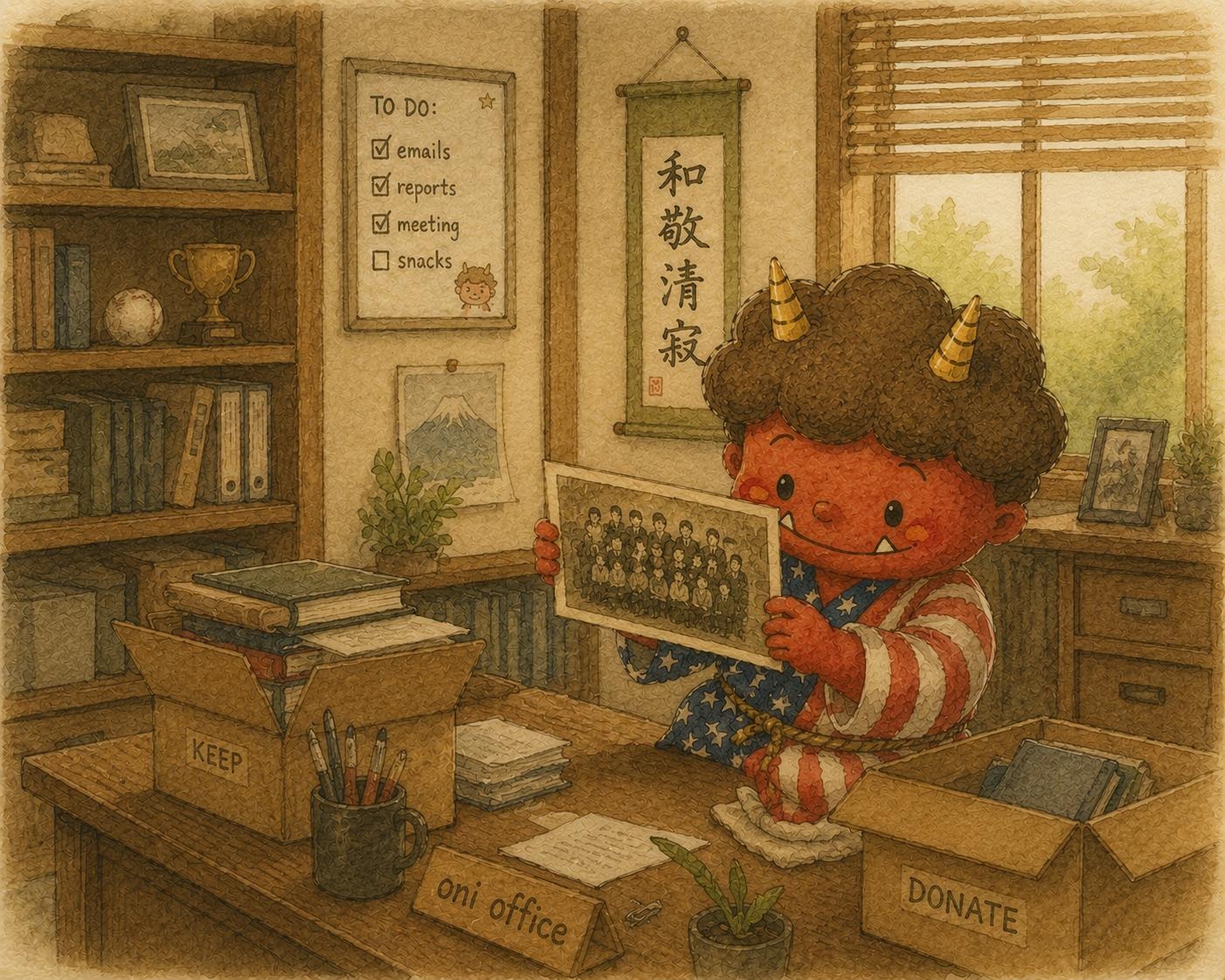
この雨の夕べ、散らかりきった執務室の片づけにようやく取りかかりましたところ、私がまだ若造で、鬼としての正しい生き方を学んでいた遠い昔の卒業アルバムを偶然見つけたのでございます。
ご存じのとおり、戦い、踊り、歌、狩り、そして咆哮――これらはすべて、善良で高潔な妖怪の心を豊かにし、精神を育むために欠かせません。人間の学校も、この点では案外よく似ております。ただ一つ、私の限られた観察によると、棍棒の正しい扱い方を学ぶことは、近年あまり歓迎されていないようですね。
おそらく、ほかの武器が好まれるようになったからなのでしょう。伝統を重んじる我ら鬼は、古来より棍棒を振るう術を守り続けておりますので、過去にとらわれた種族と思われることもございます。
ええ、古風どころか野蛮に映ることさえあるでしょう。ですが、我らは実に変わり者の種族なのです。たとえ数百年ごとに新しい流行が現れようとも、変化を好まないことだけはご理解いただきたいのでございます。
そんな折、私はあることに気づきました。それまで一度も不思議に思ったことはありませんでしたが、おそらく多くの発見とはそういうものなのでしょう。長い年月を重ね、幾度となく旅をして、ようやく目に入るものがあるのです。
私にも、かつての同級生たちも、誰ひとり制服を着ていなかったのでございます。
Greetings again dear readers and may you all be well! On this rainy eve, I had finally gotten around to organizing my highly cluttered office and, I happened to come across an old yearbook from many moons ago when I was still a young stripling and learning the proper ways of the Oni. You know, fighting, dancing, singing, hunting, and roaring – all the essentials necessary to enrich the minds and cultivate the spirit of a good and upright yokai. I assume human schools are quite similar in this regard, with the exception that learning how to properly strike with a club is, according to my limited observations, somewhat discouraged nowadays. I suspect this is due to the fact that some other weapon is preferred and that we Oni, being quite fastidiously attached to our traditions, are seen as rather stuck in the past for clinging to the ancient art of club-swinging. Yes, I know it may seem old-fashioned or even barbarous, but you must understand that we are a peculiar breed and most reluctant to change even if a new trend emerges every few hundred years or so. It was at this point I noticed something that had never truly struck me as unusual before but perhaps it was, like so many things, a realization that only could’ve been made with the benefit of many years and many travels. Namely, I realized that neither I nor any of my old classmates were wearing any uniforms.
さて、これは古代ギリシャの哲学者であり、技術者であり、数学者でもあったアルキメデスのように、浴槽から飛び出して裸のまま街中を駆け回るほどの「ひらめき」ではありませんでした(ええ、これは本当にあった話なのです。信じられるでしょうか。そして、どうやらあれがアルキメデスの最初の奇行というわけでもなかったようです)。彼の風変わりな振る舞いや幾何学への並々ならぬ情熱、さらには驚くべき戦争用機械については、プルタルコス英雄伝(「マルケッルスの生涯」)をお読みいただければ、より詳しく知ることができます。
Now, this may not be the sort of epiphany that would cause one to leap from the bathtub and run around town naked in a state of euphoria like Archimedes the ancient greek philosopher, engineer, and mathematician (yes, that really happened, can you believe it? And apparently, shocking though it was, this wasn’t the first time Archimedes had done something strange or behaved oddly. You can read more about his curious behavior, his obsession with geometry and his incredible war machines and engines in Plutarch’s Parallel Lives in The Life of Marcellus – there’s a Japanese translation too, but it’s known as the プルタルコス英雄伝).
いずれにせよ、それは世界を揺るがすような発見ではありませんでしたが、「なぜ制服や決まった服装の伝統がある学校、さらには部活動、職業もあれば、ないものもあるのだろう」と考え始めるには十分でございました。どうかご理解ください。我らアメリカの慎ましき鬼は、日本に住む親戚たちほど洗練されてもおらず、優雅でもないのでございます。
ちょうどその頃、日本に住む親戚が、コーヒーでも飲みながら少し話そうと、ふらりと立ち寄ってくれました。私はこれはよい機会だと思い、その写真を見せたのです。
「うわっ、あの頃はもっと小さくて、痩せてたね!」
そう言われて、私たちは大笑いしました。
「でも、確かに制服がないね。あれは大変じゃなかった?」
At any rate, it wasn’t that sort of a revelation but was enough to set my mind at work and consider why some schools, activities, and professions have uniforms and a well-established tradition of style, while others do not. We humble American Oni, you must realize, lack the refinement and elegance of our Japanese cousins. Speaking of which, it was right around this time when a Japanese cousin of mine popped in for a cup of coffee and brief chat, and I thought it the perfect opportunity to show him the photograph. “Wow, you were much smaller then, and thinner too!” he remarked and we had a good laugh. “But say, that’s true, no uniforms! Wasn’t that a pain?”
その瞬間、私は思いました。
―また出ましたな。
どれだけ頑張っても、どれだけネイティブらしく使おうとしても、どうにも要領がつかめない、日本語独特のあの表現でございます。
「大変……というのは、制服がないことが大変だった、という意味ですか?」
私はそう聞き返しました。
きっと「大変」には、私がまだ理解しきれていない意味があるに違いありません。あるいは文脈を聞き逃したのかもしれませんし、またしても従兄弟の話を半分しか聞いていなかったのかもしれません。
もっとも、それも無理はないのです。
彼には、話の途中でふらりとどこかへ行き、別のことを始めてしまうという、なんとも不思議な癖があります。時には「じゃあね!」と明るく言い残し、そのまま玄関から出て行ってしまうことさえあるのです。
認めるのは少々癪ですが、気が散りやすい私が、身体まで落ち着きなく動き回る相手と会話をしているとなれば……お互いの話を少しでも理解できていること自体、ほとんど奇跡でございます。
おそらく、お互いの風変わりなところを受け入れる余地がたっぷりあるからこそ、案外うまく付き合えているのでしょう。
しかし、私の問いに少し意表を突かれた従兄弟は、こう説明してくれました。
「ああ、そういうことか。毎日着るものを自分で選ばなきゃいけないだろう? それって、ちょっと面倒じゃないか?」
For a moment I thought, “Now here once more is one of those thorny Japanese expressions that I never truly got the hang of no matter how hard I tried and how often I tried to use it like a native speaker.” “A pain…you mean was it troublesome NOT having a uniform?” I inquired, seeking clarification. Surely, there must be some other meaning of “面倒臭い” that I hadn’t yet grasped or perhaps the context had escaped me, or perhaps I had once again exhibited the bad habit of only partially listening to my cousin because he has an even stranger habit of walking away to do something else while speaking – sometimes even while heading out the door before giving a cheerful, “See you later!” So, when one whose mind admittedly tends to wander is engaged in conversation to one whose body tends to wander…well, it’s a great wonder that either of us understand what the other is saying at all. Perhaps this is why we tend to get on rather well, as there is great latitude for understanding in each other’s eccentricities. Yet my cousin, caught off guard at what should have been such a simple statement, began to expound. “Well, yeah, I mean having to pick something different everyday. Isn’t that sort of a hassle, you know?”
そんな発想は、私には一度もありませんでした。
おそらく、身分の低い鬼である私は、虎の皮の短パンを三着しか持っておらず、そのどれも兄のお下がりで、一着だけ少し色あせていることを除けば、ほとんど見分けがつかなかったからでしょう。
そこで、ふと思いました。
もし私が、多くの人間のように、靴やズボンやシャツ、それにネクタイや帽子まで身につけなければならないとしたら、どうなるのでしょう。
毎朝、あれだけたくさんのものを選ばなければならないなど、考えただけで疲れてしまいます。
The thought had never occurred to me, perhaps because being an Oni of humble origins I only had the three pairs of tiger-skinned shorts and they were all, more or less, identical with the exception that my older brother’s hand-me-downs were slightly faded. Then I thought, what if I, like so many humans, had to wear shoes, trousers, a shirt, a tie, a hat, etc. etc. Why, having to select all those items every day would be downright exhausting!
「なるほど、それは確かに面倒ですね」
私は素直に認めました。
自分の考えが十分伝わったことに満足したのでしょう。従兄弟は私の新聞を「借りる」と、そのまま持っていき、コーヒーのお礼を言いながら玄関へ向かいました。
そして別れ際、最後にこう付け加えたのです。
「僕たち日本人が、あんな退屈な作業を毎日続けられるのは、最初に制服を着るからだと思うよ」
まるで大いなる知恵を授けた賢者のような満足げな表情で、彼は礼儀正しくうなずくと、静かにその場を後にしました。
“I suppose you’re right that would be rather tedious.” I conceded. My cousin, who was now quite satisfied that he had made his point and, after “borrowing” my newspaper began to head for the door thanking me for the cup of coffee and, before bidding a final farewell noted, “I think that’s why we Japanese are able to focus on such uninteresting tasks, because we have to put on a uniform first.” Now feeling as though he had dispensed with some genuine wisdom, he gave a polite nod and was gingerly on his way.
もちろん、私は新聞そのものにはそれほど興味がありませんでした。ただ、彼がもう少し長居をして、その考えについてさらに話せたらよかったのに、とは思いました。
というのも、そのときになって初めて、自分がすっかり慣れてしまっていたことに気づいたからです。
それは、この素晴らしい「日の出ずる国」を初めて訪れたとき、私を何より驚かせたもの―制服の多さでございました。
駅員の皆さんは、役職に関係なく、いつもきちんとした制服を身につけ、多くの場合、男性も女性も、一目でそれと分かる実に見事な帽子をかぶっておられました。
しかし、それは公的な職務に就く人々だけの話ではありません。(私たちアメリカ人にとって、制服といえば消防士や警察官、それに医師や看護師くらいでしょう。)
日本では、どこへ行っても制服が目に入るのです。
大きなデパートには、案内所で美しく制服を着こなした案内係の方々が立っています。郵便局も、地元の銀行も、パン屋もそうです。さらには建設作業員、畳職人、ガソリンスタンドの店員に至るまで、それぞれの仕事に、それぞれの制服がありました。
これを私の子ども時代の記憶にたとえるなら、まるでリチャード・スキャリーの絵本の中へ入り込んだような感覚でした。ただし、それがすべて現実なのです。しかも、現実離れしているどころか、あまりにも現実らしく整っているのでございます。
もしまだご覧になったことがなければ、ぜひ一度手に取ってみてください。あの絵本のイラストは実に見事で、細部まで描き込まれています。観察好きな子どもなら、何時間でも夢中になって眺めていられるに違いありません。
Now, of course I had no real interest in the newspaper, but I do wish he had stayed a bit longer to discuss the idea a bit further. For, it was then I realized that I had grown so accustomed to something that – upon my first visit to the splendid land of the rising sun – had initially struck me with absolute wonder, namely: the abundance of uniforms. Every train station employee – regardless of position – wore an immaculate uniform, often times with a very sharp-looking cap with a sense of easily recognizable features both for men and women. But, it wasn’t only those engaged in “official duties” (for we Americans have uniforms for fire-fighters, police officers, doctors, nurses, and the like) but it was seemingly everywhere you went. Large department stores and there “information centers” were always attended by well-dressed uniformed ladies but, the post office, the local bank, the bakery, and even more industrial or artisanal professions such as construction workers, tatami-makers, and even gas station attendants all had their respective uniforms. If such a thing can be compared to my own child-hood experience, it was a bit like looking through one Richard Scarry’s marvelous children’s books, except it was all real, almost too real one might say! (Have you ever looked through one his books? You should! The illustrations are wonderful and the attention to detail will easily keep the most precocious and keen-eyed youth occupied for hours).
日本で暮らし始めた最初の数年間、私がこの少し不思議で、それでいて実に魅力的だと感じた「均一性」の中でも、とりわけ印象深かったのは、それが祖父母の育ったアメリカとは、まるで別世界のように思えたことでした。
それは、祖父母がついに知ることのなかった場所への郷愁にも似た感覚でした。そして、日本を訪れたあと、多くのアメリカ人が振り返って語る思いでもあるように感じます。
私は、この光景がいつまでも変わらず残ってくれることを願っております。
Perhaps one of the most significant things about this uniformity that I found so charming, if a bit surreal, upon my first few years in Japan was how much it seemed like a parallel world to the America that my grandparents grew up in. It made one feel nostalgic for a place that they never knew, which is something many Americans find themselves saying after reflecting upon a visit to Japan, and I pray it’s something that never changes.
なぜ私たちは制服や画一性にこれほど強い抵抗を覚えるのでしょうか。いや、より正確に言えば、それは後から身につけた抵抗感なのかもしれません。
おそらく、個性や自立を重んじる文化の中で育つと、「集団に身を委ねれば、自分らしさや独自性、他者との違いを失ってしまう」と、どこかで考えるようになるのでしょう。
三島由紀夫は、「太陽と鉄」の中で、四十歳を過ぎてから短期間だけ陸軍で訓練を受けた際、軍服を身につけるうちに、その役割は自己意識を剝ぎ取り、一人の「戦闘員」となることなのだと悟った、と記しています。
さらに彼は、個人の思想や欠点、内面の生活までもが、死に備えるため、より大きな集団という悲劇的な様式へ吸収されていくのだ、とも述べています。
もちろん、こうした考え方は、JRの駅員の制服に込められた思想とは大きく異なるでしょう。
それでも彼は、軍隊とは、どれほど些細に思える任務であっても、それがより大きな目的へ向かう準備の一部であると感じさせる場所だ、とも語っています。そして、その発想は、今日では大企業が掲げる理念や「ミッション・ステートメント」にも、どこか受け継がれているように思えるのでございます。
ちなみに、英語の「company」という言葉も、その語源をたどれば軍事用語に行き着きます。現在でも、歩兵大隊を構成する最小単位を指す言葉として使われています。
もっとも、親愛なる読者の皆様。この言葉には、もう一つ、ずっと穏やかで心地よい意味もございます。
それは、「何かをともにする仲間たち」という意味でございます。
As to why we have such an aversion or, to put it more accurately, such an acquired distaste for uniforms and uniformity, well that may have something to do with the fact that the stress upon individuality and independence leaves one thinking that if you give yourself over to the group-will you’ll invariably lose what makes you special, what makes you different, and what sets you apart. Mishima Yukio, in his indispensable Sun and Steel, describes how when in the process of donning the uniform during his brief period of training in the army (he was a man past 40 then) he came to the understanding that the purpose of the uniform was to strip away one’s sense of self so that one could simply become a “combatant,” and the ideas, faults, and inner-life was to be subsumed into the greater tragic mode of the group as a means of preparation for death. While this might differ significantly from the philosophy behind the colors and design of the uniform of the average JR station attendant, his further commentary on how the army offers one a sense that any duty – no matter how seemingly trivial or small – is part of a greater preparation for necessary action, is something that carries into the mindsets and “mission statements” of even the largest companies today. Even the word “company” in English has its origin as a military term and is still used today to denote the smallest subset of an infantry battalion. Though we should not forget, dear readers, that it also carries a deeper and more pleasant meaning, namely: a group of friends on a endeavor.
そう考えますと、冒険へ出かける仲間同士がお揃いの服を着ることに、そこまで反対する理由があるのでしょうか。
むしろ、これほど相性のよい組み合わせも、なかなか思い浮かびません。
実のところ、多くのアメリカらしい事柄と同じように、スポーツの世界に限って言えば、私たちは制服にほとんど抵抗を感じていないようです。
そして、スポーツにおけるユニフォームという仕組みは、実によくできています。
もし選手全員が「自分らしさ」を優先し、その日の気分で好きな服を着ていたら、白熱した試合の最中に味方を見分けるのは、さぞ骨が折れることでしょう。
さらに面白いことに、ファンの皆さんまでが―試合に出場するわけでもなく、ただピッチやグラウンド、あるいはリングの周りで声援を送るだけにもかかわらず―群衆の一員となり、「チームの一員」であることを楽しんでいます。
そのため、応援するチームへの思いを示そうと、同じユニフォームを身につけるのです。
その日だけは、普段の仕事着を喜んで脱ぎ捨て、お祭りのための別の制服へ着替えるのでございます。
And so, it is odd to think that we should be so against dressing alike with a group of friends on an adventure, for what could be more congenial? Indeed like with so many peculiar American things, we seemingly have no problem with this configuration when it comes to sports. And this business of uniforms in sports, is indeed a very clever thing, because it surely would be decidedly difficult to identify one’s teammates in the heat of competition if everyone was dead-set on “being individualistic” and wore whatever struck their fancy on that particular day. Why, even the fans (who do not participate in the actual match whatsoever, but merely shot and cheer in the area surrounding the pitch/ground/ring) enjoy being part of the throng and “part of the team.” As a result, they are bedecked in identical uniforms to show their support for their chosen squad and for an evening or an afternoon very eager to forgo their standard “work uniforms” for another uniform of a more festive nature.
最後に、一つ付け加えておきたいことがございます。
もし誰かが、はっきりとした好みや自分なりのスタイルを持っているなら、それもまた一種の「ユニフォーム」になるのではないでしょうか。
いつもサングラスをかけている人気芸能人、野球帽を愛用する人、あるいは―神よ、どうか我らをお守りください―ネッカチーフを好んで身につける人まで、皆それぞれに独自の「見た目」を築いています。そして結局のところ、それもまた、その人のユニフォームなのでございます。
この奇妙な話をさらに進めますと、もしロックバンドのメンバーが、東京のごく普通のサラリーマンのように、きちんとしたスーツにネクタイ姿で舞台へ現れたら、おそらく観客は皮肉か冗談だと思うでしょう。
なぜなら、美しい青いスーツにウィンザーノットのネクタイは、どう考えてもエレキギターを弾くための「ユニフォーム」には見えないからです。
もっとも、アンガス・ヤングだけは、なぜかそれさえ見事に成立させてしまいましたが。
In closing one must also consider that if a person has truly well-defined tastes or styles then this too ends up becoming a “uniform” of sorts. For example, even popular entertainers with a flair for sunglasses, or a penchant for baseball caps, or even – may the gods preserve us – neckerchiefs, end up developing a certain “look,” and in the end this too becomes their uniform. By this strange development, if the member of a rock band were to dress in a formal suit and tie like the average Tokyo salaryman, this would surely be construed by the audience as an ironic jest, because “a nice blue suit and a Windsor-knot tie” is decidedly the wrong sort of uniform for playing electric guitar (though, somehow Angus Young of AC/DC managed to even make that work).
結局のところ、服装やスタイルについてあれこれ考えることに疲れ果て、「もうたくさんだ!」とばかりに、アルキメデスよろしく裸で走り回ることにしたとしても、実に皮肉なことに、最後に残るのは最も「画一的」なもの―つまり身体そのものなのです。
In the end, even if one was to find all this business of clothes and styles too great of a burden to bear and, in a fit of joyous rebellion, ran about naked like Archimedes this would, paradoxically, leave one with the most uniform thing of all, “the body.”
ええ、ずいぶんとややこしい話になってしまいました。
ですが、その責任の大半は私の従兄弟にあるのでございます。 Until next time, take care dear readers!
それでは、親愛なる読者の皆様。また次回まで、どうぞお元気で。
Yes, it’s all rather confusing and I blame my cousin mostly. Until next time, take care dear readers!
“What a splendid land this is, and how lovely are its people! Fear not, I promise not to eat anyone!”
-Aka-Oni