目次
Chicken Soup or おかゆ
親愛なる読者の皆様、またお会いできて光栄でございます。皆様お元気でお過ごしでしょうか。
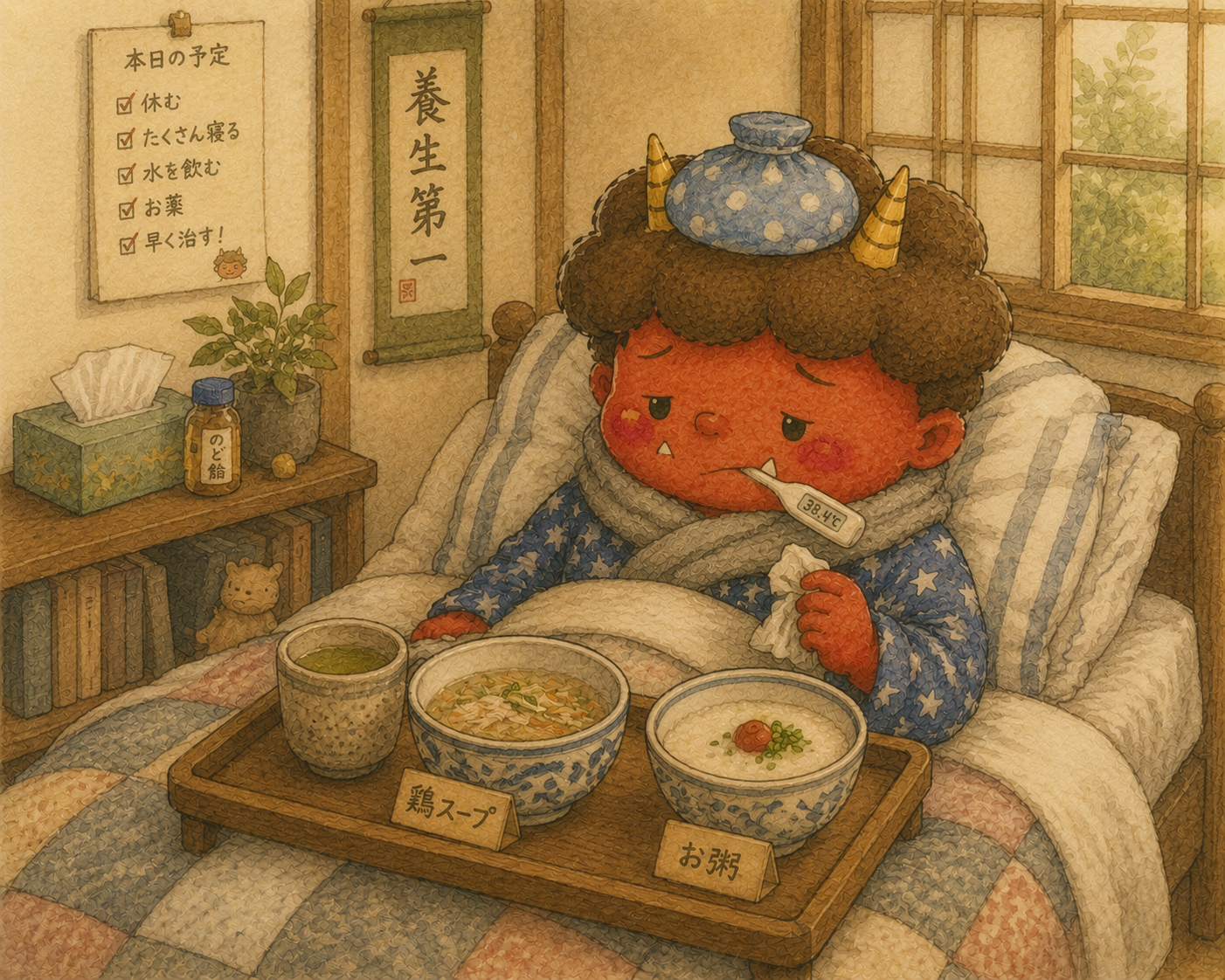
私の方はと申しますと、正直なところ、もう少し元気でありたいところなのです。そう、私たち妖怪も病にかかりますし、どれほど屈強な鬼であっても、ときには風邪をひいてしまいます―あるいは、さらに厄介なことに、花粉症に悩まされることさえあるのです。
驚いたことに、今なお多くの人が、私たちが風邪で寝込むと火を噴いたり、真っ黒な煙の渦を吐き出したりすると信じているようですが、そのような幻想的なことは一切ございません。炎が少々出ることはありますが、ヴェスヴィオ山や富士山の噴火と見間違えるようなものではないのでございます。
煙の「渦」につきましては、まあ、「渦」という言葉は私なら使いませんね。特に、痰を吐くたびに必ず現れるわけでもないことを考えれば、「水蒸気」と呼ぶ方がずっと正確でしょう。それより、そうした不快な話はお好きな方々にお任せするとして、鼻水との戦いに関しては、人間も私たちもそれほど変わらないという点に目を向けてみましょう。
意外に思われるかもしれませんが、私たちにも昔から伝わる民間療法がございます。回復を早めるだけでなく、自分を気遣ってくれる大切な存在がいるよいう幸せを思い出させてくれます。チキンスープは、ほとんどあらゆる生き物にとって―もちろん鶏を除けばですが―まるで奇跡のような効き目を持っているようです。
Hello again, dear readers and may this find you well and vigorous. As for myself, I must confess that given the present circumstances, I could be doing better. Yes, it’s true we yokai can fall sick and even the stoutest and mightiest Oni, every now and again, find themselves down with a cold – or perhaps even worse yet, with hay fever. It is still, much to my surprise, the belief among many that we sneeze fire and cough up billows of pitch-black smoke when incapacitated by a cold but I assure you there is nothing so fantastic and the flames, although they do emerge on occasion, are hardly the sort of thing one might mistake for an eruption of Mt. Vesuvius or Fuij-san for that matter. As for the billows of smoke, well “billows” is hardly the word I would use to describe it. I think “vapor” would be a fairer and more accurate description especially in light of the fact that is not necessarily produced with every expectoration. Instead, let us leave these unpleasant details for someone with an interest in such things and look to the way in which we are not so different from mankind when battling “the sniffles.” You may be surprised to know that we have our own home remedies, tried and true, that help facilitate a speedy recovery and remind us of how fortunate we are to have loved ones to care for us. Chicken soup seems to work wonders for almost any sort of creature I suppose (that is, of course, excepting chickens).
さて、多くの読者の皆様がご存じの通り、この伝統には先祖代々の言い伝えだけではなく、現代的な裏付けもございます。もっとも、何千年にもわたり効き目が確かめられてきた治療法に、グラフや数字だの、人々が「科学」と聞いて思い浮かべる奇妙な液体入りの小さなガラス瓶だの、そうした面倒な科学というものを必要とするのかは少々疑問ではありますが。
とはいえ、白衣を着た人間たちがようやく他の人類や妖怪たちと同じ結論にたどり着き、スープはただ美味しいだけではなく、炎症を和らげ、痰をゆるめ、必要な栄養を血液へ送り届け、特にひどい風邪で弱っている時には消化もしやすいと確かめてくれたのは、実に喜ばしいことでございます。
Now, as many of you are keenly aware that there is some modern evidence for this tradition beyond the folksy wisdom of one’s ancestors and, not that thousands of years of a battle-tested remedy need to bother with all the difficulties of charts, and numbers, and whatever those little glass bottles filled with strange liquids are called that people seem to associate with the word “science.” Still, it’s nice to know the uniformed lab-coat humans have finally caught up with the rest of mankind/yokai-kind and confirmed that soup, apart from being delicious, helps reduce inflammation, loosen mucus, deliver much needed nutrients into the bloodstream, and is easier to digest when one is flattened by a particularly unpleasant cold.
日本にも、それに負けない工夫があります。「お粥」と呼ばれる料理です。大まかに訳せば「ライス・ポタージュ」といったところでしょうか。しかし、この響きでは、まるで『オリバー・ツイスト』の主人公が、厳しい校長にきっぱり断られる前に頼みそうな一皿を思い浮かべてしまいます。
ところが実際は、とても美味しい料理なのです。そして、多くの日本の伝統料理と同じく、肉が見当たらず、その栄養豊富なタンパク質が欠けているにもかかわらず、体を温め、消化にも優れ、免疫力に確かな活力を与え、体が侵入者と戦う助けをしてくれることから、風邪の時の定番として広く親しまれています。
さらに、お粥にはチキンスープにはない、実に日本らしい長所があります。それは、とにかく簡単に作れることです。
自家製のチキンストックを作ったことがある方ならご存じでしょう。あれは実に万能で、チキンスープを作るなら間違いなく最高の土台になります。しかし、作るには強い決意と、たっぷりの時間―たいてい6時間以上―が必要です。しかも、それだけ費やしてようやくスープの「土台」だけができあがるのです。
親愛なる読者の皆様、はっきり申し上げますが、ここまでの工程はすべて「下ごしらえ」に過ぎません。ストック(出汁)ができても、まだ何一つ完成してはいないのです。ようやくスタートラインに立ち、「さて、これからスープを作りましょう」と言える段階なのです。
ですから、風邪のウイルスと死闘を繰り広げている最中に作り始めるものではございません。これは元気な時に済ませておく仕事です。そうしないと、親切ながら少々口うるさい年配の叔母が、まったく慰めにならない調子でこう言うでしょう。
「チキンストックがないですって?」
スープやさまざまな料理の土台を作る文化を持つ日本人も、もちろん「だし」をこよなく愛しています。それでも、ここでは実用性が勝っているようです。日本版の「風邪の時のチキンスープ」であるお粥は、ずっと少ない手間で作れること自体が、大きな魅力なのでしょう。
ましてや、鶏そのものの下ごしらえまで考え始めたら大変です。
「丸鶏を買ったんでしょう?」
千年は生きていそうな鬼の叔母が、また小言を始めます。皆様の中には、もうその声が聞こえてきた方もいらっしゃるかもしれません。
「まさか胸肉だけ買って済ませたなんて言わないでちょうだい!」
Similarly, the Japanese too, in their own clever fashion, have a dish called お粥 which translates roughly to “rice porridge” and makes it sound like something Oliver Twist might ask for before being roughly repudiated by a cruel headmaster. However, it’s actually quite pleasant and despite being conspicuously bereft of any meat (as many Japanese traditional dishes are) and the accompanying nourishing protein contained therein, it too is much touted as a cold remedy not only for its warmth and digestibility but for the apparent “charge” it gives the immune system, helping the body take arms against an invading foreign adversary. Now お粥, unlike chicken soup, has another striking quality which speaks to the surprising practicality of many Japanese customs and traditions, namely: it is very simple to make. As anyone who has trodden down the road of “making your own chicken stock” knows, that while it certainly serves a myriad of uses and is – without question – the only true way to make chicken soup, it requires great resolve and an abundance of time, typically more than six hours or so, and all for extracting the “base” of what is to become the soup. Let me be explicit dear readers, this is all what is commonly referred to as “prep.” Once the stock is complete you have finished nothing, and are effectively still at the starting line. “Now, you can begin to make the soup.” Therefore this is absolutely not to be attempted while one is “in the throes of battle,” as it were, with a cold virus. No, this is something that “you should be doing regularly,” and when the time comes a kindly but irritating old aunt will offer (most unhelpfully), “What do you mean you don’t have any chicken stock?” The Japanese, who are no strangers to creating bases for soups or other dishes, have a great fondness for だし (soup stock), but it seems here that cooler heads have prevailed and one of the indirectly supportive aspects of the Japanese equivalent of “chicken soup for a cold” is that it can be made with considerably less effort. This is to say nothing of now preparing the chicken itself, “You did buy a whole chicken, didn’t you?,” your thousand year old Oni-aunt begins to chastise. I assume many of you can practically hear her now, “Don’t tell me you just bought chicken breasts and threw them in some canned mix!”
いいえ、ここにはトヨタの「ジャスト・イン・タイム」を生み出したのと同じ精神が息づいております。私のように料理の才能に恵まれない鬼でも、市販のお粥セットを簡単に見つけられますし、気分に合わせて生姜や梅干しを少し加えることもできるのです。
もちろん、アメリカ人だって手軽に食べられる食品に縁がないわけではありません。スープと聞けば、多くの人が真っ先に思い浮かべるのはキャンベルのロゴでしょう。もっとも、その知名度にはアンディ・ウォーホルも少しは貢献したのかもしれませんが。
風邪をひいている時に温かい食べ物―とりわけスープやお粥―を口にすると、不思議なことに、その素朴さがいつにも増してありがたく感じられます。
ひどい風邪をひいている時は、どれほど好き嫌いの多い人でも、それを気にしなくなるものです。おそらく体が、「与えられたものをありがたく受け取りなさい」と教えてくれているのでしょう。
もっとも、偏食といえば、私のいとこは少々極端でして、料理の温度が理想どおりでないだけでも食べません。それだけではなく、「数えられる食べ物」は必ず偶数個でなければ気が済まないのです。
おわかりになりますでしょう? フライドポテト、インゲン、エンドウ豆、オクラ―細長い野菜なら何でもそうですし、切った果物も例外ではありません。
私は以前、ベイクドポテトやサーモンの切り身、ステーキにはどうしてその決まりを当てはめないのかと尋ねたことがあります。たいてい一人前につき一つですから、「奇数」になってしまうはずです。
すると彼は深いため息をついて言いました。
「ああ、君には私の言っていることがまるで伝わっていないんだね。」
まあ、仕方ありません。何しろ彼はニュージャージー出身なのです。気の毒ですが、それだけで十分な罰を与えられているのかもしれません。
No, it is here wherein the same spirit that created the “Just in Time” system at Toyota is at work and even a clumsy and culinarily maladroit Oni such as myself can easily find pre-made mixes of お粥 and perhaps add a dash of ginger or pickled plum if desired. However, one also must consider that Americans aren’t exactly strangers to readily consumable foodstuffs and that when speaking of soup there is hardly a logo more recognizable than Campbell’s (although perhaps some credit should be extended to Andy Warhol too). The truly strange thing about hot foods (particularly soup/お粥) when one is suffering with a cold, is that we appreciate their simplicity all the more. When down with a nasty cold, even the pickiest of eaters have their preferences melt away. I think perhaps this is also our bodies way of telling us to be thankful and accept graciously what we are given. Incidentally, speaking of picky eaters, I have a cousin who not only refuses to eat a dish if – for example – the temperature is not ideal, but also demands an even number of what one might call “countable edibles.” Oh, you know what I mean: french fries, green beans, peas, okra (any stringed vegetable really) and any variety of sliced fruit for that matter. I once asked why he didn’t apply this condition to a single larger item such as a baked potato, or a salmon filet, or a steak, since they are almost always served as as “one” item, thereby being an “odd numbered dish.” He responded with a heavy sigh claiming, “Oh, it’s impossible for you to understand anything I suppose.” Well, what can one do? He’s from New Jersey after all, the poor devil, and that’s punishment enough.
念のため申し上げておきますが、あの「終わった後なら何とでも言える」で悪名高い叔母たちのようにはなりたくありません。それでも、風邪を防ぐ方法はいくつかございます。
「予防は治療に勝る」という古いことわざにもあるように、その中でも最も簡単なものの一つが、十分な睡眠なのです。
おそらく人間は、いつも仕事や義務、何かしらの予定に追われているのでしょう。そのため睡眠は、健康や幸福に欠かせない習慣というより、どこか邪魔なもののように扱われている気がいたします。
アレクサンドロス大王はかつて、睡眠と―少し上品に言えば「愛を交わすこと」ですが―その2つこそ、自分が「凡人」であることを思い知らされるため、最も嫌っている行為だと語ったそうです。(ちなみに、この話はアレクサンドロス大王東征記に詳しく載っています。実に素晴らしい一冊でおすすめでございます。)
さて、私のような一介の田舎鬼は、この数多の世界を股にかける偉大な妖怪でも半神でもありません。それでも、もしあの頃にアレクサンドロスと会えていたなら、一つ教えて差し上げたいことがありました。
私の知る妖怪や、それ以外のさまざまな生き物たち―もちろん「凡人」でも「人間」でもない者たちですが―の多くは、朝日が昇り、昼になってもなお、怠け者のナマケモノ以上に眠ることを愛しているのです、と。
実際、私の小さな一族だけでも、週に二日以上まとめて眠らないなど考えもしない鬼が少なくとも三人おります。それ以外の暮らし方は、不自然とまでは言わずとも、ずいぶん奇妙に映ることでしょう。
もし私がアレクサンドロスの遠征に同行していたなら、その征服が実に見事だったことは素直に認めたうえで、ワインは少し控えめにして、もう少し眠り、ご自身の体を大切になさるよう勧めたに違いありません。
これも人間らしさの一つなのかもしれませんね。
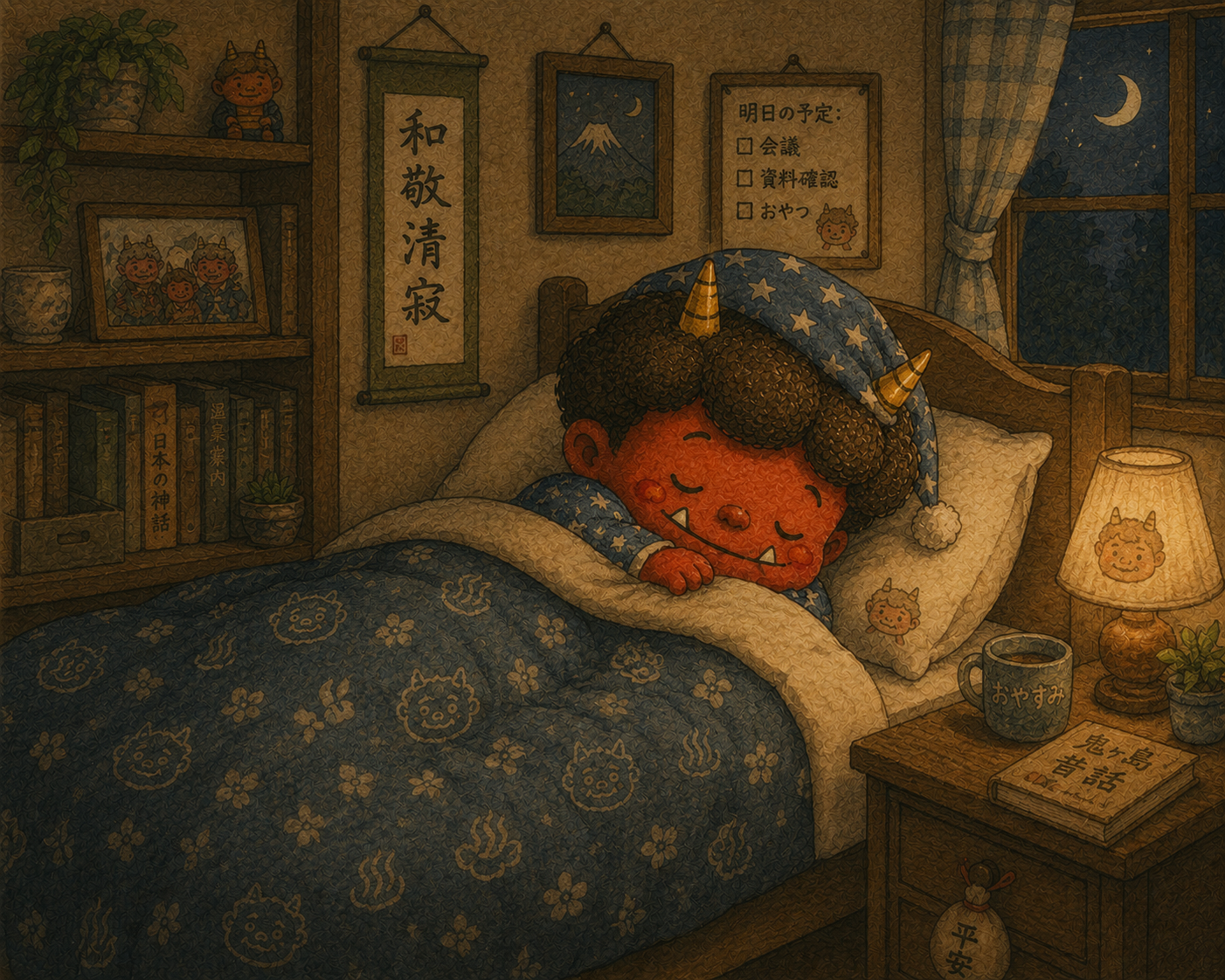
さて、親愛なる読者の皆様。どうか私が布団へ戻り、モルフェウスの腕の中へ這い戻ることをお許しください。
皆様が良い夢をご覧になりますように。Pleasant dreams to you all, and to those who are sick, get well soon!
そして、今まさに風邪と戦っている方々には、一日も早いご回復を心よりお祈りしております。
I should note that, while not wanting to sound like one of my notoriously hind-sighted aunts, there are a number of simple means to stave off colds in the first place. In the spirit of the old adage “an ounce of prevention is worth a pound of cure,” one of the very simplest is sleep. I think perhaps it is due to the fact that humans are always so very busy and so preoccupied with some task, duty, or scheme and so, sleep seems largely to be an inconvenience to many of them, as opposed to an utterly essential practice for overall health and happiness. Alexander the Great once observed that sleep and the act of what might, in more polite terms, be called “making love,” were the two actions he most disliked as they reminded him of his state as a“mortal man.” (You can read more about this in Arrian’s history of Alexander the Great, by the way. It’s a wonderful text!) Well, speaking only as a humble country Oni and certainly not a great yokai or demigod of these many woven realms, I wish I had known Alexander back then so as to tell him that I know a great many yokai and other creatures that are not technically what one might call “mortal” and certainly aren’t “men” who relish sleep more than the laziest sloth to ever occupy a futon as the morning sun passed into its noonday brightness. Why, at least three Oni in my own tiny clan wouldn’t dream of sleeping less than two whole days per week, and would look at anything else as deeply strange if not outright unnatural. Had I been there with Alexander, you know on campaign, I would have been glad to assure him that his conquests were indeed spectacular and he really ought to look after himself with a bit less wine and a bit more rest. Such is the folly of man, I fear sometimes. And on that note, dear readers, I do hope you won’t begrudge me too much if I crawl back to my futon and into the arms of Morpheus. Pleasant dreams to you all, and to those who are sick, get well soon!
“What a splendid land this is, and how lovely are its people! Fear not, I promise not to eat anyone!”
-Aka-Oni